
- Five steps of the Hunt model from awareness of the problem to the desire to pay for its solution
- How to apply the Hunt model in content using the example of the hosting and domain niche
- Why this model is important for content marketing
Sometimes it happens that the content seems to be done correctly: the text is clear, the structure is logical, the offer is formulated clearly. But there is no expected reaction — people read the post, article, or landing page and simply move on.
In such moments, it is easy to start changing the wording or design, although the problem may lie elsewhere: part of the audience is simply not ready for the proposed solution.

Five steps of the Hunt model: from awareness of the problem to the desire to pay for its solution
The Hunt model is a framework proposed by marketer Ben Hunt to describe how a person's readiness to purchase changes. It is dedicated to the logic of decision-making: people do not move from indifference to purchase instantly; they gradually change their level of awareness of the problem and the need for a solution.
In fact, this model structures five states in which a potential client can be. And its main value is that it forces us to look at the audience not as "traffic," but as people with varying degrees of readiness to act.
Ben Hunt is an American marketer and author of the book "Convert! Designing Web Sites to Increase Traffic and Conversion." It is in this book that he described the model now known as the Hunt stairs.
In fact, the idea itself was not entirely new. Hunt developed and adapted an earlier model of buyer awareness described by copywriter Eugene Schwartz back in the 1960s. His concept explained how a person's state changes from complete unawareness to readiness to buy a product.
Ben Hunt essentially rethought this logic for digital marketing and showed how it can be used when creating websites and content.

Ben Hunt
If you want to get to know the author of the updated methodology, here is his website, where Ben Hunt presents his services as a freelance consultant.
- First level — lack of awareness of the problem. At this stage, a person is not looking for a solution and does not respond to commercial offers because they do not feel the need. For example, a business owner may not associate low sales with the quality of the landing page or the speed of the website. Therefore, they will not seek services for its optimization or change website hosting to obtain a better technical base.
- Second level — awareness of the problem. There is an understanding that the situation requires changes. The potential client does not yet know what specific solution they need, but they are starting to look for explanations for the reasons.
- Third level — searching for solutions. The focus shifts from the problem to ways of solving it. At this stage, the audience actively consumes information: reading materials, analyzing approaches, getting acquainted with tools.
- Fourth level — comparing alternatives. The problem and possible solutions are already understood. Now it is about choosing between specific offers, brands, or formats.
- Fifth level — readiness to purchase. The decision is essentially made, and key factors include conditions, convenience, trust, and clarity of the offer.
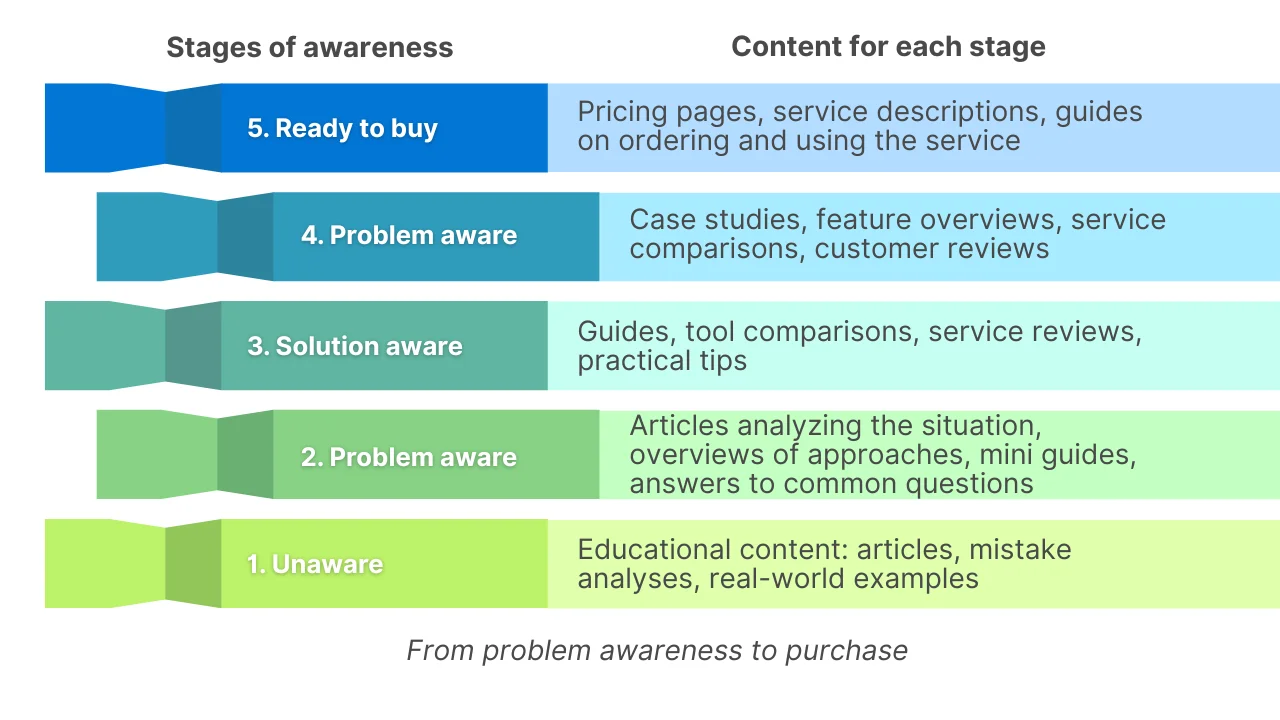
The Hunt stairs show that different segments of the audience are simultaneously at different levels. And if the content is focused only on those who are already ready to buy, it simply will not work for the rest.
Also read: How to attract more comments to your blog
How to apply the Hunt stairs in content using the example of the hosting and domain niche
To understand how this model works in real content marketing, it is worth looking at a specific niche. In the field of hosting and domains, the Hunt stairs are clearly visible because the audience comes with varying levels of understanding of the topic: some are just thinking about creating a website, while others are already choosing a provider.
At the first level, the user is not yet thinking of hosting or a domain as a separate service. Their interest may relate to launching a website, developing a business online, or creating an online project. Therefore, content at this stage is usually broader than the product itself. In the blog, this could be materials like "How to create a website for business", "What is needed to launch an online store" or "How much does it cost to host a website on the Internet". Such content gradually leads the reader to understand that a domain and hosting are needed for a web resource to function.
At the second level, the problem is already formulated: the user knows that the website needs a technical foundation, but they do not yet fully understand how it works. Here, requests for basic explanations arise — what hosting is, why a domain is needed, how these elements interact. In the content, this looks like explanatory articles: "What is hosting and how does it work", "What is the difference between a domain and hosting" or "How to choose a domain name for a website".
When the user moves to searching for solutions, they are already interested in specific options. People start reading reviews, comparisons, and practical guides. In the blog, this could be materials like "Which hosting to choose for WordPress", "What is better: VPS or regular hosting" or "How to register a domain".
At the stage of comparing options, the audience already has several possible services and is evaluating them against each other. Here, materials that help understand the differences work well: comparisons of tariffs, breakdown of features, use cases, or customer reviews. For example, articles like "How to choose a hosting provider: what to pay attention to" or "10 parameters to compare hosting" work well.
And finally, at the level of readiness to purchase, the user is looking for clear information about the service itself. Here, pages with tariffs, descriptions of characteristics, conditions for domain registration, or instructions for transferring a website are important.
This approach clearly shows that content for a hosting project is not limited to commercial pages. Some materials help the audience understand the problem, some help find solutions, and only a few directly offer the service.
Why this model is important for content marketing
In content marketing, one strategic mistake is often made: the audience is perceived as homogeneous. All analytics boil down to "traffic," and communication is reduced to a universal message that is supposedly supposed to work for everyone.
But website visitors and social media users come with varying levels of readiness for a solution. If a commercial page is shown to a person who has not even formulated the problem yet, they will simply close the tab — not because the offer is bad, but because it is premature.
The opposite situation also occurs. When a company publishes only educational content for years and avoids direct conversation about the product, the audience that is already ready to choose a supplier does not get an answer to the main question: "Why you?"
That is why the Hunt stairs are useful for content planning. They help understand what materials are needed at different stages: from explaining the problem to arguments in favor of a specific solution. When these elements work together, content stops being a collection of separate articles and begins to function as a system.