
- What is a target audience portrait
- Who needs a target audience portrait and why
- How to collect data for a target audience portrait
- How to form a target audience portrait
- What to do with the formed target audience portrait
In 2024-2025, Google prioritized "people-first" content: materials that help users ranked better than mass-generated text for search engines. However, the question arose as to how to create products and promote them in the market to meet specific customer needs. To do this, it is necessary to define the target audience, then separate groups and personas. So let's break down how to form a customer portrait from a blank slate to a finished persona card that will help improve products, select marketing channels, and increase conversion.

What is a target audience portrait
A target audience portrait (TAP) is a structured description of a specific group of people who are most interested in your product or service. Having it allows you to better understand who you are selling to and why that person wants to buy your goods or use your services.
For example, we offer a reliable virtual server for hosting small and medium internet projects. One of the portraits of our target audience will be a freelancer developer aged 25 and older who wants to quickly host client websites. He has already used the services of other providers, but under load, the web resources crashed, and he received negative feedback from clients. And now he is looking for a solution with enough resources for an unlimited number of domains, mailboxes, and traffic, which we offer, plus one month of free use.
Who needs a target audience portrait and why
The TAP will be useful for anyone selling goods or offering services, that is, working with clients. This can include business owners, SEO specialists, marketers, project managers, targeters, copywriters, content managers, sales department workers, or support services. They will be able to better convey important information specifically to those people who really need it, thus fulfilling the key task of satisfying the needs of potential or existing clients.
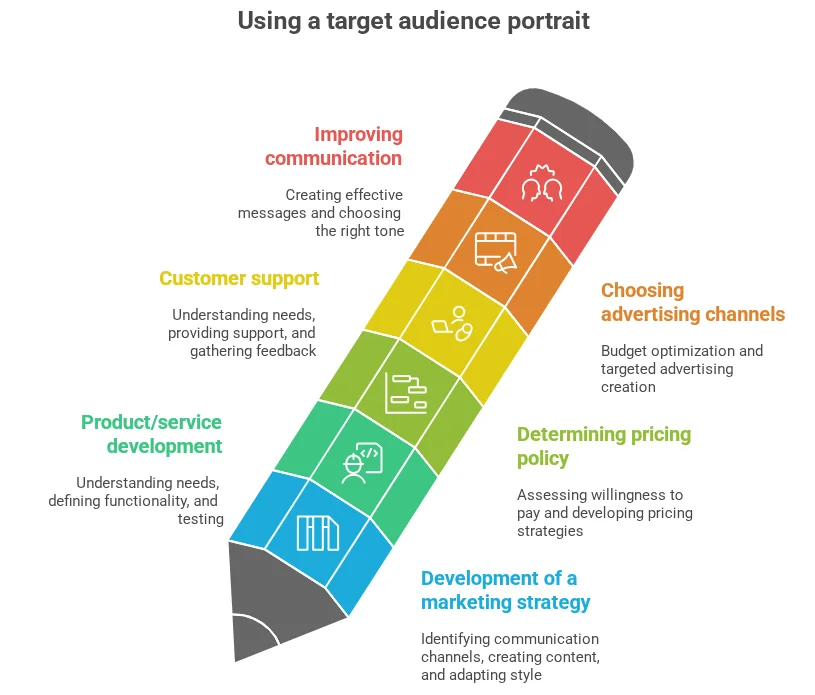
For better understanding, let's consider what tasks the target audience portrait performs:
- Budget optimization. Of course, you can launch advertising campaigns for everyone. However, this would be a waste of money: a person wants to find an air conditioner with heating for 15,000 hryvnias that heats well, works quietly, is easy to operate, while you are telling about models for 219,000 hryvnias with Plasma Quad, HEPA, ultraviolet lamp in the ad.
- Choosing traffic channels. Each social network and content platform offers various content, so it is difficult to say clearly "TikTok for youth, Facebook for the older generation." However, people who want to buy slime are more likely to watch bright and short videos on TikTok, Instagram Reels, or YouTube Shorts than to search for articles on LinkedIn.
- Creating a content plan. The better the target audience portrait, the easier it is to create content. You know which topics to choose for texts on service/product pages and articles in the blog, in what style to create materials, and what to focus on. You can effectively allocate resources, for example, directing 80% to Reels and 20% to classic posts on Instagram.
- Improving the product. Business owners and individual specialists often have the impression that they already know the needs of customers. Target audience portraits can confirm or refute this notion. For example, analysis shows that buyers of knitted toys are not those looking for "cheaper," but people who want a warm, pleasant, unique gift. Then you invest not in saving materials but in quality, design, style, and packaging.
- Building a customer base. In the book "Customers for Life," Carl Sewell talks about treating the customer not as a one-time consumer but as a person who will return many times if heard, supported, and provided with what is promised. And the TAP helps to understand how people make decisions, what they fear, what they value, and what motivates them to return. Based on this data, you can segment email campaigns, personalize landing pages, build different interaction scenarios, and create precise product offers.
And it is worth highlighting websites separately. We have already talked about the change of Google algorithms, the development of artificial intelligence, and the traffic pit that formed when transitioning from old to new. And when you already know your audience, you can focus on quality rather than quantity.
That is, you do not need to create 300-500 articles "about everything in the world" in the hope that something will work. Instead, you can do less but significantly better: write deep expert content that addresses your clients' real questions, uses their lexicon, and shows an understanding of their situations and pains. This approach is now more effective for SEO and helps to gain long-term traffic at a time when Google is actively fighting against "content for the sake of content."
How to collect data for a target audience portrait
Analyze your own product, study competitors, gather information on forums and social networks, conduct audience surveys, look at reviews, take data from research and your own statistics — and this is just part of the methods. Available methods generally depend on the current state of your business: whether it is just being developed or already operational and has clients.
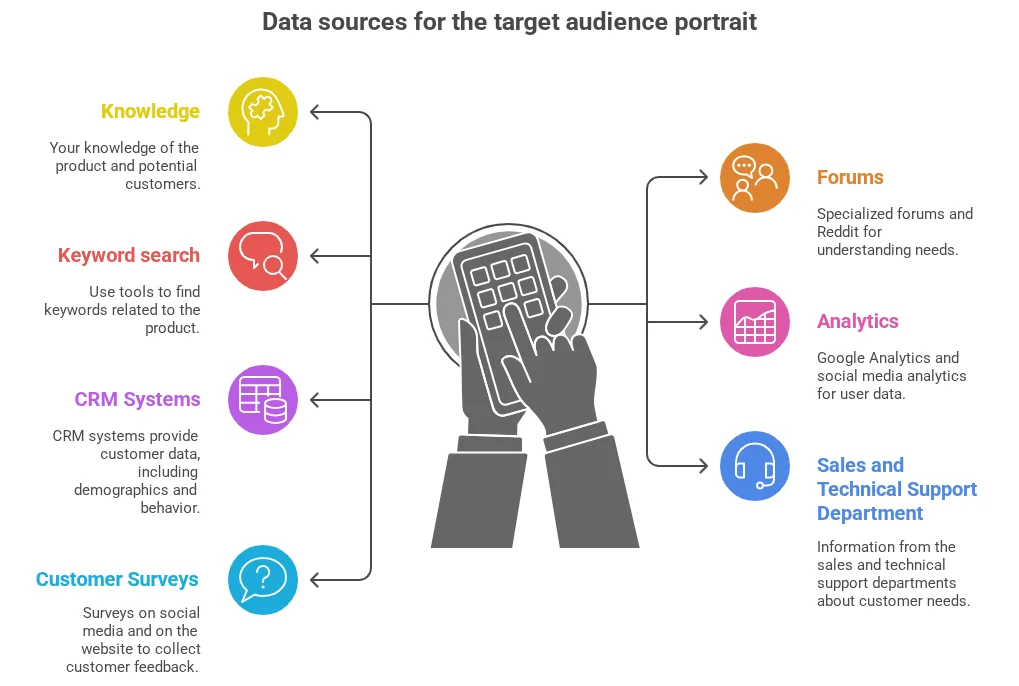
Where to get data for a target audience portrait when developing a product
When you have an idea or a product in development, finding data is more challenging. However, there is still enough information to understand potential customers. You need to work with the market, competitors, and hypotheses, after which you can move on to precise data.
There are several ways to collect data for a target audience portrait without an active project:
- Your knowledge. You already know your product, accordingly, who and why it may be needed. Next, you will confirm or refute your assumptions, but overall this is a good starting point.
- Competitor analysis. If you are creating a store selling Hot Wheels cars, enter the query "buy Hot Wheels cars" into the search engine and visit 5-7 competitor websites or social media pages. Look at the comments they write, what questions they ask, what they praise, and what they criticize. For quick searches, use Hotline (Ukrainian market), Amazon, or Etsy (international).
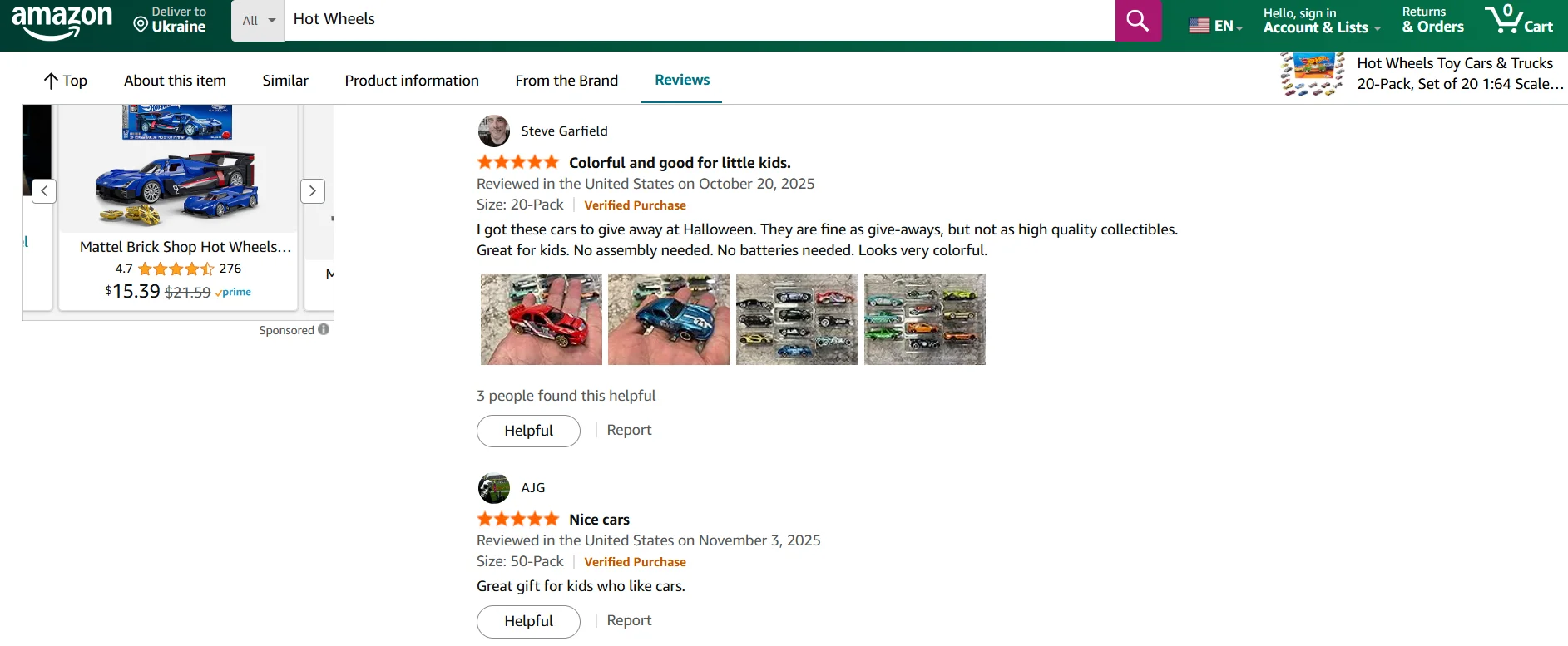
Amazon is a great source of data for the target audience portrait, especially if you have or plan to create an international business.
- Forums. It is better to look for specialized forums, but Reddit will also do. Search for discussions you need or create them yourself. In addition to specialized groups, find general posts, for example, what is lacking in modern online stores.
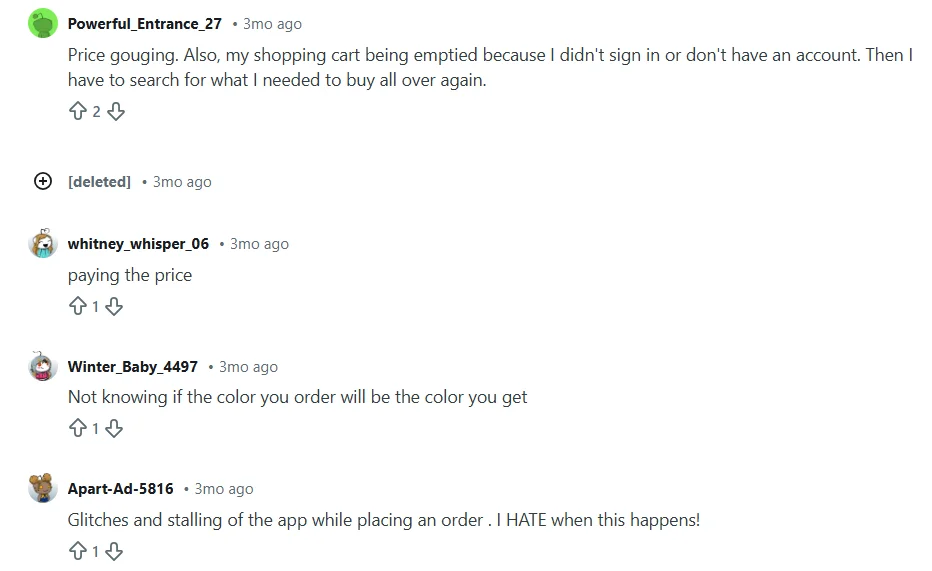
An example of such a discussion on Reddit. Some of the most common problems with online stores are crashes, as well as losing your shopping cart when reloading the page.
- Keyword search. This is important not only for websites but also for social media pages. You can use Google Keyword Planner, Free Keyword Tool from WordStream, or Free Keyword Generator Tool from Ahrefs for free.
Without customers, the process of researching the target audience is built on assumptions: you find information from the sources mentioned above → build hypotheses → conduct testing → adjust data. For example, there are men aged 30-45 looking for rare Hot Wheels models to replenish their collection. Of course, you expand this portrait based on the collected information, conduct A/B testing, and adjust the data.
Where to find data for a target audience portrait for an active business
If there is a website, an account on a content platform, and/or a social media page, the situation is significantly simplified. To determine the target audience, you only need to properly utilize the available data sources:
- Analytics. For websites, there is Google Analytics, services, and CMS plugins. For example, MonsterInsights clearly displays data from GA4, while WP Statistics is an independent system. Social networks also have built-in analytics; for example, Pinterest, Instagram, and TikTok provide useful information about the entire account for free, while Twitter is only available for a fee (basic rate 89 hryvnias). In any case, this method allows you to learn about age, gender, cities, behavior, devices.
- CRM systems. For businesses, a CRM system is a must-have, as it provides all data about customers, including name, age, city, position, company, popular products/services, average check size, purchase frequency, and so on.
- Sales and technical support department. A useful source of information for analyzing customer desires and pains. You can learn what questions are asked most often, what reasons there are for refusing to purchase, what they like, and what they criticize.
- Surveys. Periodically publish posts and stories with surveys, for example, "Do you like our new design?" or "What payment methods for goods are most convenient for you?" Even simple questions like "How old are you?" or "Who is from which city?" can provide useful information and increase the number of comments on your posts. On the website, add a survey after placing an order, for example, with WordPress plugins like WPForms, Gravity Forms, Modal Survey, Quiz Maker, WP-Polls.
The above methods + knowledge about your product + competitor analysis + opinions from forums = maximum effectiveness. This way, you reduce the risks of losing an important audience segment you might not even have suspected, thus obtaining a complete database for accurately creating the TAP.
Read also: What can a heat map of a website tell you and how to create it
How to form a target audience portrait
You already know what a target audience portrait is, where to get data for projects in development and active business. Now all that remains is to gather everything and properly format it, which we will do together now.
To make it easier for you to understand, we will show the process using our own example. That is, the starting point is the hosting provider Cityhost with services for domain name registration, virtual hosting rental, VPS, dedicated server.
We conduct segmentation
Even with information from the sources we previously mentioned, you cannot immediately proceed to creating the TAP. Moreover, we do not even know how many target audience portraits are needed, and making one for everyone is not possible, as it will be inaccurate. So first, we use our own knowledge about the product and the available data and conduct segmentation — we form groups of people with similar behavioral logic.
For example, virtual hosting is bought by beginners, small business owners, and small web studios, VPS is for medium companies, startups, web studios with many projects, while dedicated servers are for large businesses. Now we can already see 4 different target audience portraits:
- beginners (creating a website for the first time) — virtual hosting;
- small and medium business owners — virtual hosting with an easy transition to VPS;
- web studios and individual SEO specialists — may need all products, depending on the size of the company, number of clients, current tasks;
- large companies — sometimes VPS, but mostly dedicated servers for complete independence and self-selection of configuration.
The optimal number of target audience portraits is 2-4. As we have already said, you cannot stop at one, as there is a risk of losing important nuances and a large number of potential clients. If you take more than four, it is easy to get confused.
Read also: How to promote an online store: strategy for increasing traffic and sales
We create basic portraits
Now we will build on the previous information, forming clearer motivations and key triggers:
- Beginner. He wants quick results, to press a couple of buttons and have the site already working, but is afraid to do something wrong. Price is important for him: resources are limited, and it is his first experience, so he is not ready to overpay for features he does not understand and that he does not need right now. And for such people, the principle of "guiding by the hand" works great: simple instructions (better both text and video), a tour of the control panel, tips at every step, 24/7 support.
- Small or medium business owner. He takes the project seriously, has already invested money, so he fears losing clients due to failures or slow page loading. He wants everything to be transparent, while not wanting to delve into technical details, so support service and guarantees are important here.
- Web studio or SEO specialist. The key point is reputation. The previous category also cares about reputation, but for an SEO specialist, a site that often does not work is a catastrophic problem. Deadlines are constantly pressing, and the desire to appear as an expert in front of the client does not go away.
- Large company. Has zero tolerance for interruptions, as even minor problems lead to significant financial losses. Wants to have full control over the infrastructure with modern solutions. Dedicated servers with custom solutions and extended support are ideal for them.
At this stage, you will already be able to better understand the goals, values, motivations, pains, fears, triggers, selection criteria, and expectations of clients. And to obtain this information, often your own experience, stories on forums, and reviews from competitors are sufficient.
We understand the demographic characteristics
Now we move from the abstract "beginner" to more specific characteristics. And this is helped by the demographic portrait of the target audience for B2C (business to consumer):
- age;
- gender;
- city/country;
- income level;
- estimated budget;
- marital status;
- education;
- profession.
Or B2B (business to business):
- position;
- business sector;
- number of employees;
- company turnover;
- how many years the company has been in the market;
- cities in which it operates;
- who makes the purchasing decision.
You specify these points based on the characteristics of your business, specific portraits, and available data. So we will not provide examples of all our portraits to save time, but will focus on one — the beginner:
- age — 22-35 years (70% of the audience);
- gender — 65% male, 35% female;
- city — Kyiv, Lviv, Dnipro, Kharkiv, Odesa;
- profession — students, freelancers, beginner entrepreneurs, office workers wanting their project;
- income — 12,000 – 20,000 hryvnias per month (limited budget);
- education — secondary specialized, complete or incomplete higher.
For a better understanding of our target audience, we can specify the persona. For example: Dmytro, 25 years old, lives in Kharkiv, works as an office manager (salary 16,000 UAH), wants to create a blog or info site as an additional income.
Read also: How to create an entertainment website: from idea to profit
We define the behavioral characteristics
The better you know how a person spends their time, the more chances you have to capture their attention. As a result, both sides win: the person gets a solution to their problems and a tool to achieve their goals, and you get a satisfied customer.
To understand the behavioral characteristics, you need to find out:
- where they search for information, for example, Google, YouTube, Pinterest, TikTok;
- what content formats they consume: articles, classic videos, or Shorts;
- how they make purchasing decisions: do they buy impulsively or analyze proposals for several days, read reviews, seek help on forums;
- which devices they use more: do they prefer smartphones or computers;
- what attracts their attention, for example, low price, promotions, discounts, reviews.
For our beginner Dmytro, the following behavioral characteristics may apply:
- searches in Google for information about how much can be earned on a website, whether it is possible to create a web resource without programming, how to create a website from scratch, etc.;
- spends a lot of time on YouTube watching videos on the same topics;
- searches for answers to his questions on forums;
- spends a lot of time comparing hosting providers, as he is afraid of making a mistake and wants to find a quality solution at an affordable price.
Why pay so much attention to the behavior of potential target audiences? For building content strategies and advertising campaigns. For example, we know that Dmytro spends a lot of time on websites and YouTube, so we will focus on promoting service pages and the blog, a series of videos for beginners on YouTube. In the content itself, we emphasize affordable pricing, simplicity, speed, and reliability.
It is even better to describe the decision-making path for each target audience portrait. Our Dmytro may act as follows:
- Realizes the problem. He is tired of working for a boss, so he starts watching YouTube channels about passive income every evening.
- Searches for information. Dmytro decides to earn money on websites, so he starts looking for answers to all possible questions, including how to create a website from scratch, what hosting is, what a domain is, which hosting to choose.
- Compares options. Finds lists of the best hosting services in Ukraine, selects 4-5 options, and compares prices, support, ease of website creation (installing WordPress in a couple of clicks), reads reviews on forums.
- Makes a decision. Chooses our hosting because we offer exactly what a beginner like Dmytro needs.
- After purchase. Dmytro expects quick connection, explanations at every step, and immediate responses from support.
The more accurately you define the decision-making path, the better you can help people and gain satisfied customers.
We compile the portrait into a final document
We already have a lot of data, know how to step by step form the target audience portrait, but now we need to gather all the information in one place. That is, to combine motivation, goals, pains, triggers, behavior, and demographics into one clear, living portrait of a specific person, which you and your employees can then use. For this, a regular Google Document will suffice, but it is more convenient to use a more functional service; for example, we took the free version of Notion.
How to use our Notion template for the target audience portrait?
- Go to the Notion link.
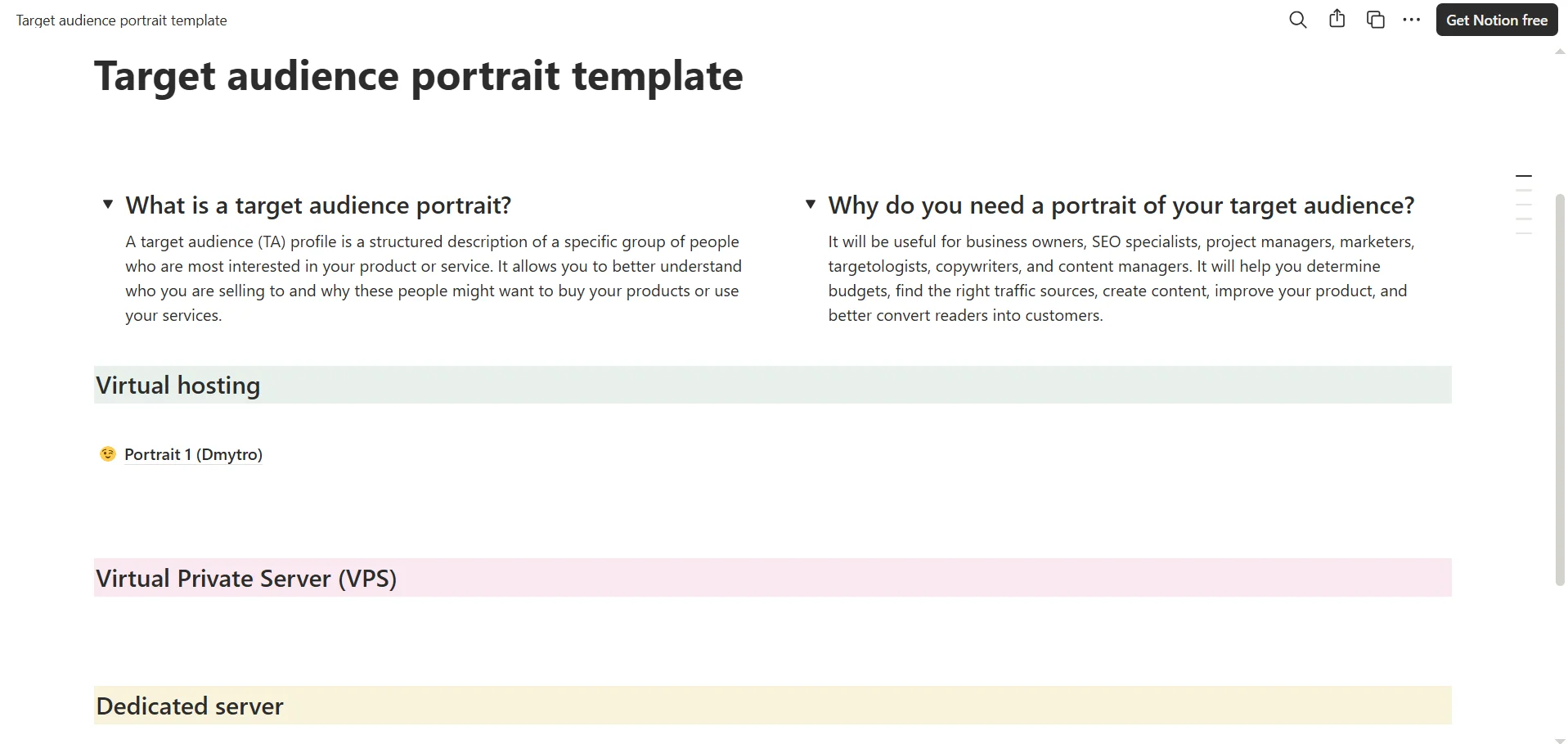
- If you do not have an account, click Made in Notion.
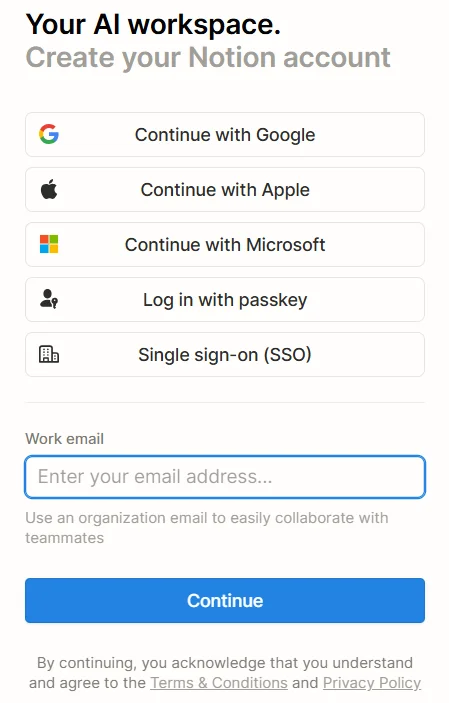
- After registration, you will be asked a few questions, but you can quickly skip everything. Then you will be redirected to the Notion homepage.
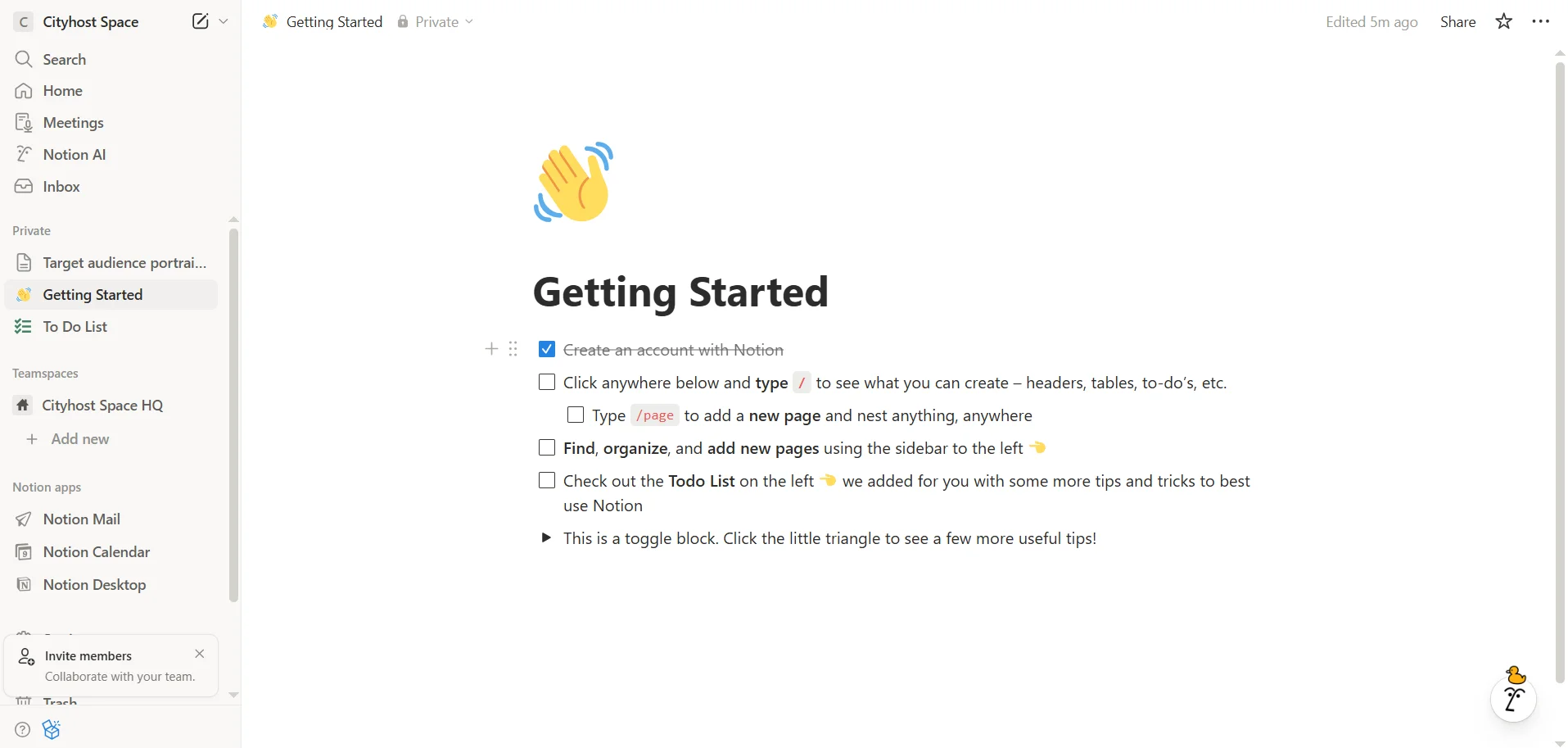
- You just need to go to the "Target Audience Portrait" page and specify data for your business. You can easily change blocks and their content, integrate Gmail, Google Drive, Slack, Trello, Zapier, and other systems.
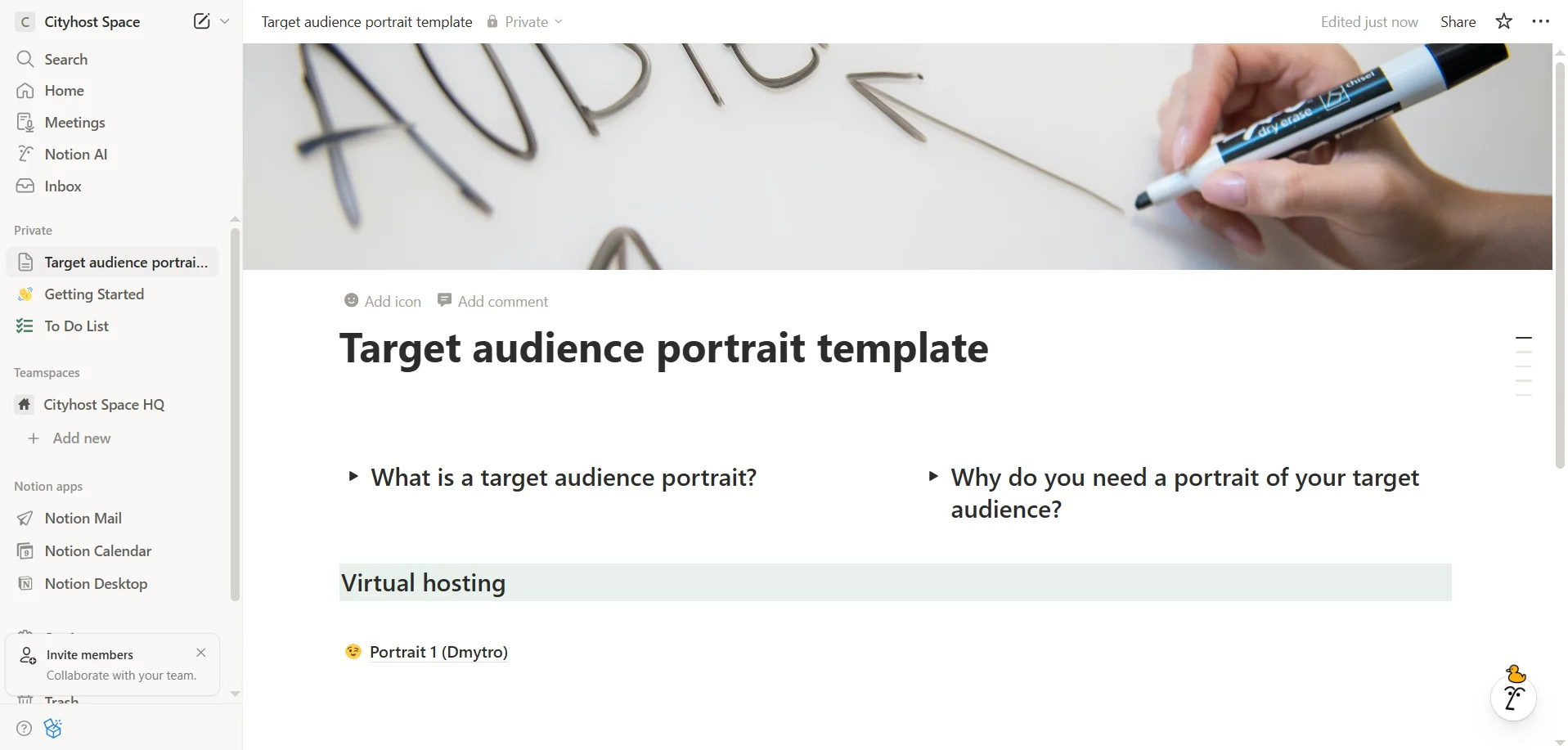
This is your template, but it is on the Notion platform, which may stop working or change functionality at any moment. So we recommend additionally copying the template structure into your Google Docs or xTiles, plus creating a PDF.
What to do with the formed target audience portrait
Test it in practice, for example, show it to the team, create advertising campaigns, conduct A/B testing, get feedback from customers through a short survey after purchase. If the result satisfies you, then share the document with each team member, base your marketing strategy on it, create technical tasks for copywriters, SEO and PPC specialists, and use it for training, for example, new support staff.
And do not forget, the target audience portrait is not a static document, but a living image of the client. Accordingly, it needs to be updated if your business scales, new categories of products or services appear, or the situation in the niche changes. And each time you can use the template and clear checklist for creating the target audience portrait described above:
- Determine how many portraits are needed. Ideally — from 2 to 4.
- Create basic options based on available data and knowledge about the product.
- Gather demographic data such as age, gender, city, profession, income.
- Define goals and motivation — what the person really wants to achieve.
- Identify pains and problems, that is, what worries the person and what they fear.
- Describe values, interests, and ways of spending free time.
- Describe how they make decisions, where they search for information, and what they pay attention to.
- Format the data into a clear final portrait.
- Test it on the team, existing clients, advertising campaigns.
- Update if the results obtained do not match the portrait.
- Use it in all areas of business, including marketing and sales.
- Regularly update (optimal period — every 6-12 months).
Final tip: do not try to create a "perfect" document. And it is definitely not worth writing a whole novel, telling about each potential client on 50-100 pages. You may have noticed this in our template: only useful, necessary information without unnecessary details. This way, you will be able to find clients, build long-term relationships with them, create a good brand reputation, and truly help people, while also increasing sales.


.webp)