- Fake fundraising for charity companies
- Fake financial aid from international organizations
- Easy online jobs from scammers
- Online stores with non-existent products
- Friendly and romantic relationships with scammers
According to the chairwoman of the board of the bank "Globus," Anna Dovhalska, in 2024, the level of losses from card fraud increased by 37%. Fundraising, financial aid from the UN, thousands of hryvnias for likes, online stores with branded products for pennies — these are just some of the ways that scammers use to obtain confidential information and steal money. That is why we decided to remind you of the current fraud schemes on the internet for 2025, which are likely to continue being used in 2026, and to discuss ways to protect yourself from scammers.

Fake fundraising for charity companies
One of the most disgusting fraud schemes is fake fundraising to support the Armed Forces of Ukraine and those affected by Russian aggression. After February 24, 2022, the crime rate significantly increased, as scammers began to exploit the desire of Ukrainians to help the military. As noted by the head of the Public Relations and Financial Awareness Department of the NBU, Lesia Voitytska, in addition to false evacuation transport and housing rental advertisements, there was already a huge number of fake fundraising campaigns observed at that time.
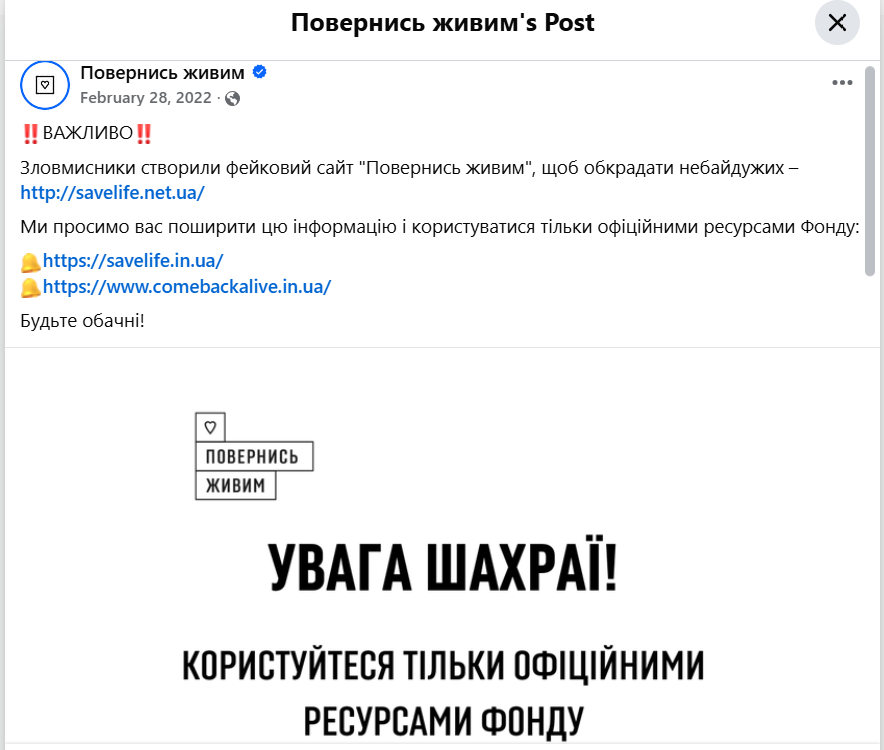
On February 28, 2022, an announcement appeared on the official Facebook page of the "Come Back Alive" fund, stating that criminals had created a fake website.
In 2022, scammers created primitive fake websites and social media accounts, published ads for "fundraising for drones" or "treatment of the wounded," and asked for donations through cards. But in 2023–2025, they took fake fundraising to a new level, starting to create professionally forged websites, fictitious accounting reports, and adding photos of fake receipts to their posts. Later, they actively used artificial intelligence capabilities, such as fake photos, videos, and even voices of military personnel.
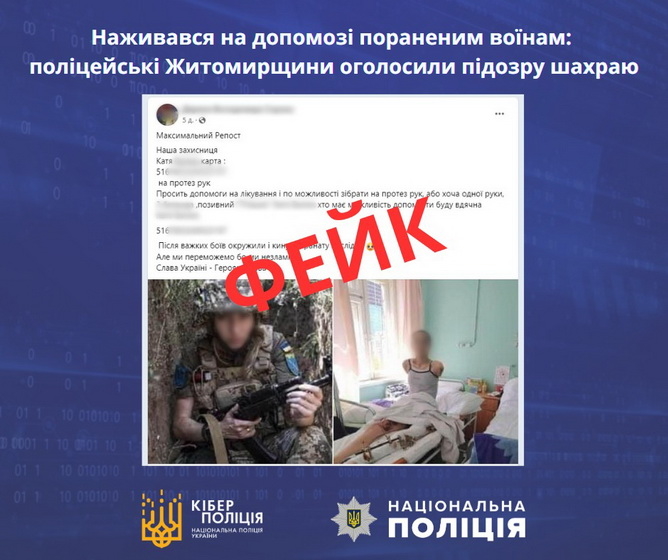
Photo from the official site of the Cyber Police. During 2023–2024, a 42-year-old man posted fake photos of two different girls. Dozens of people fell victim to the scam, with total losses amounting to approximately 300,000 hryvnias.
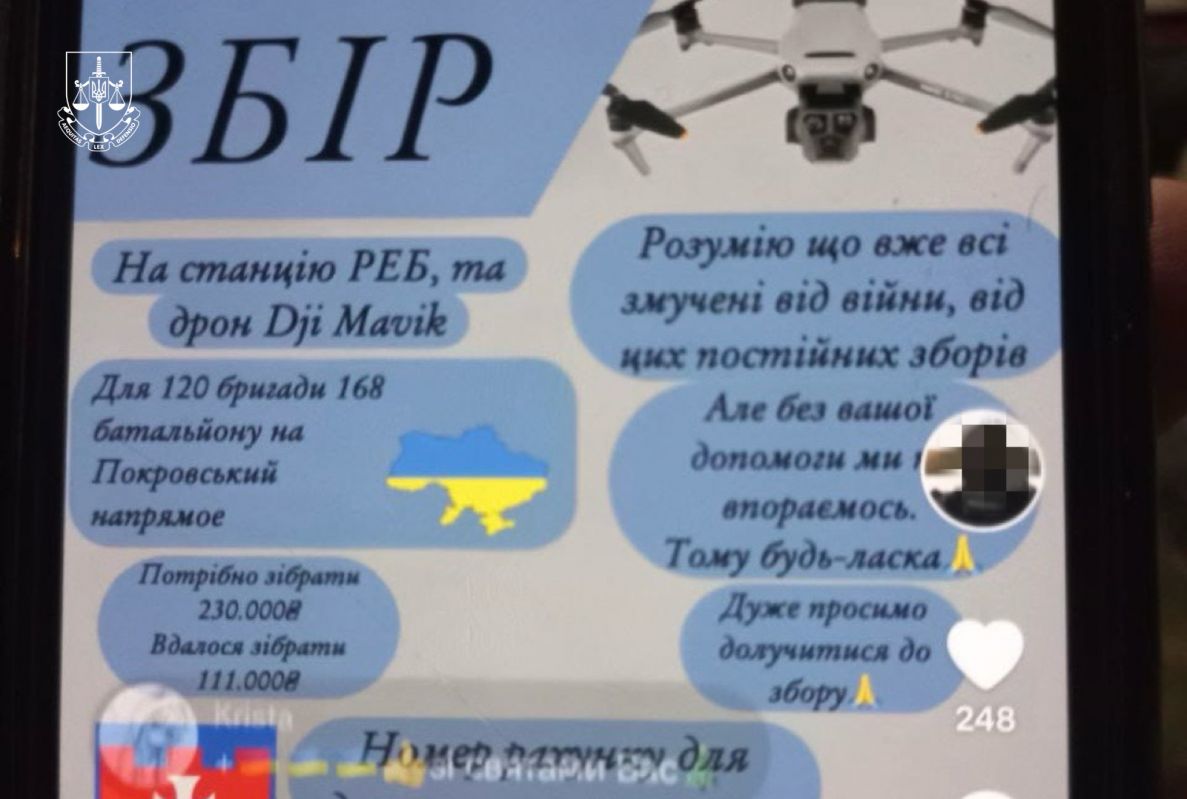
In January 2025, a news article appeared on the Cyber Police website about the detention of a group of individuals who embezzled 2.5 million hryvnias in donations for the Armed Forces of Ukraine. They created fake accounts on social media using photos of military personnel's documents and published ads for fundraising.
How to protect yourself from fake charity fundraising
In the aforementioned schemes, scammers use the same principle: they create fake accounts and publish manipulative posts with photos and videos of real volunteers, military personnel, and the wounded. They promote fundraising through targeted advertising or bots. And despite police actions, the number of such scammers is increasing, and it is becoming harder to detect them.
However, there are still basic safety rules that can help protect you from fake charity fundraising:
- Check the recipient. On social media, you can look at the account information, such as the date of joining, location, previous usernames. If it's a charity fund, go to its website and analyze the contact information (type the phone number and email into Google), legal information, reports on received and spent funds. Charity funds can be viewed on the page of the Association of Charitable Organizations of Ukraine "Members of the ABO", and you can verify the recipient through the Ministry of Justice of Ukraine website.
- Analyze the content. Use Google Images to verify contact and payment information. If you can't find information but have doubts about the fundraising, ask questions in relevant groups, such as "Stop Fraud. Accounts of fake fundraising" on Facebook.
- Check the security of the web resource. We have repeatedly stated that it is worth buying a domain and connecting an SSL certificate, as this affects not only the promotion of the site but also trust in the brand. But now let's look at this from the user's perspective. When it comes to fundraising, we recommend checking the URL (whether the domain name is genuine) of the fund and whether there is HTTPS protection.
We do not want to discourage you from helping the Armed Forces of Ukraine and charitable organizations. We also strive to help by providing free hosting and domains for hosting websites of budgetary and charitable organizations, publishing stories of funds, and regularly donating. And that is why we remind you: it is worth ensuring that the person or organization collecting funds can be trusted. This does not take much time and increases the chances that your money will go where help is truly needed.
Fake financial aid from international organizations
Scammers regularly take advantage of economic difficulties, the increasing number of internally displaced persons, and high trust in international organizations by sending emails, Telegram messages, and Viber notifications about the possibility of receiving money from international organizations. To receive financial aid, you only need to follow a link and fill out a form, after which they steal money from your bank cards. Or after sending the form, they ask you to conduct a "test transaction" to supposedly verify the account's activity.
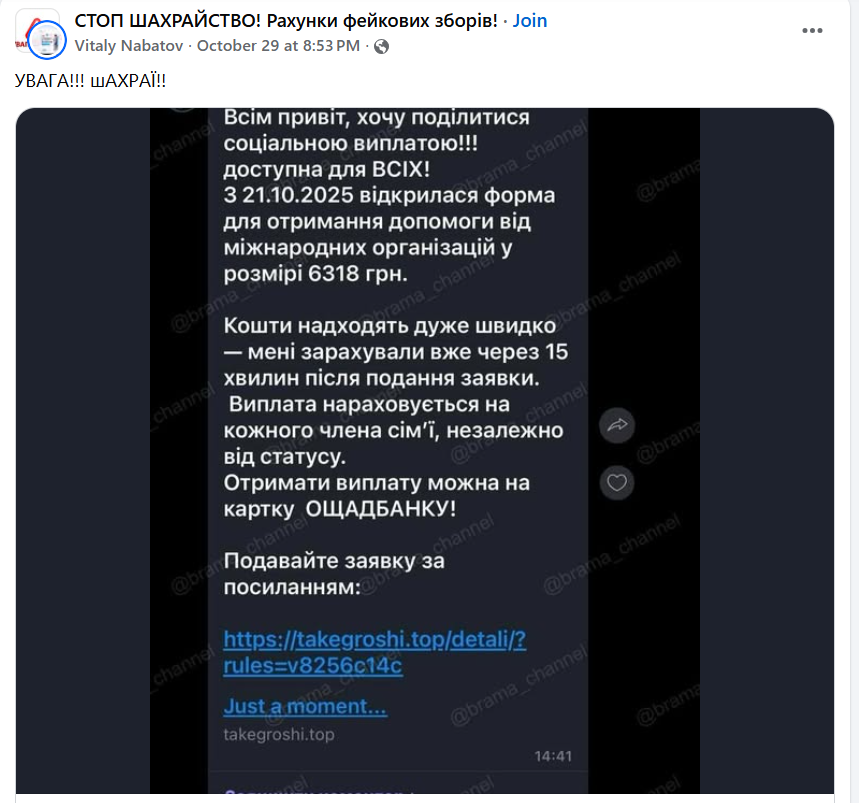
A post on Facebook about fake financial aid. The scammers were even too lazy to come up with which international organization is providing assistance.
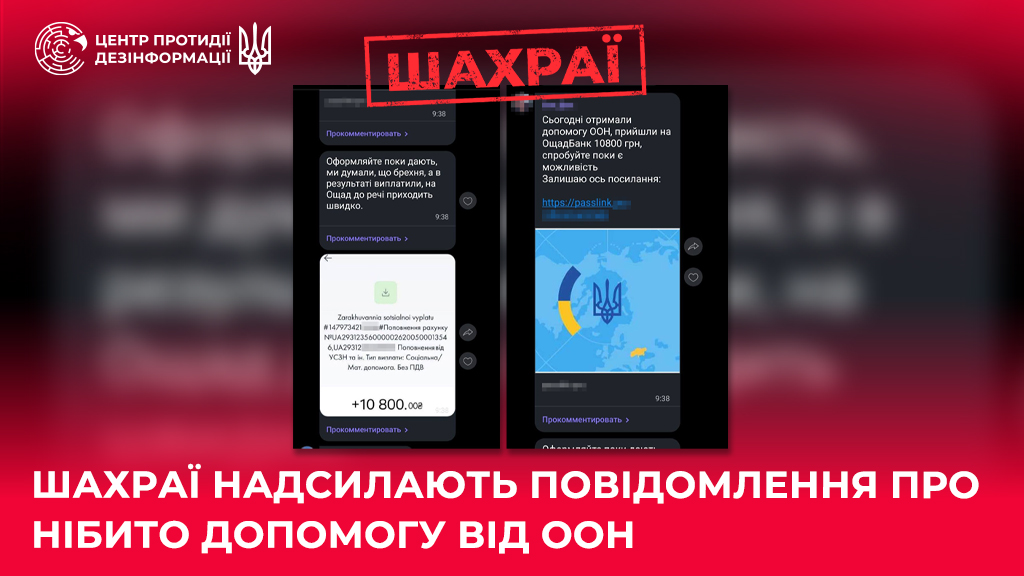
A photo from the website of the Center for Counteracting Disinformation. Such assistance does exist on the UNHCR website, but to receive it, you need to meet a number of criteria. And most importantly — you need to gather a package of documents and undergo an in-person interview with UN staff at one of the data collection points.
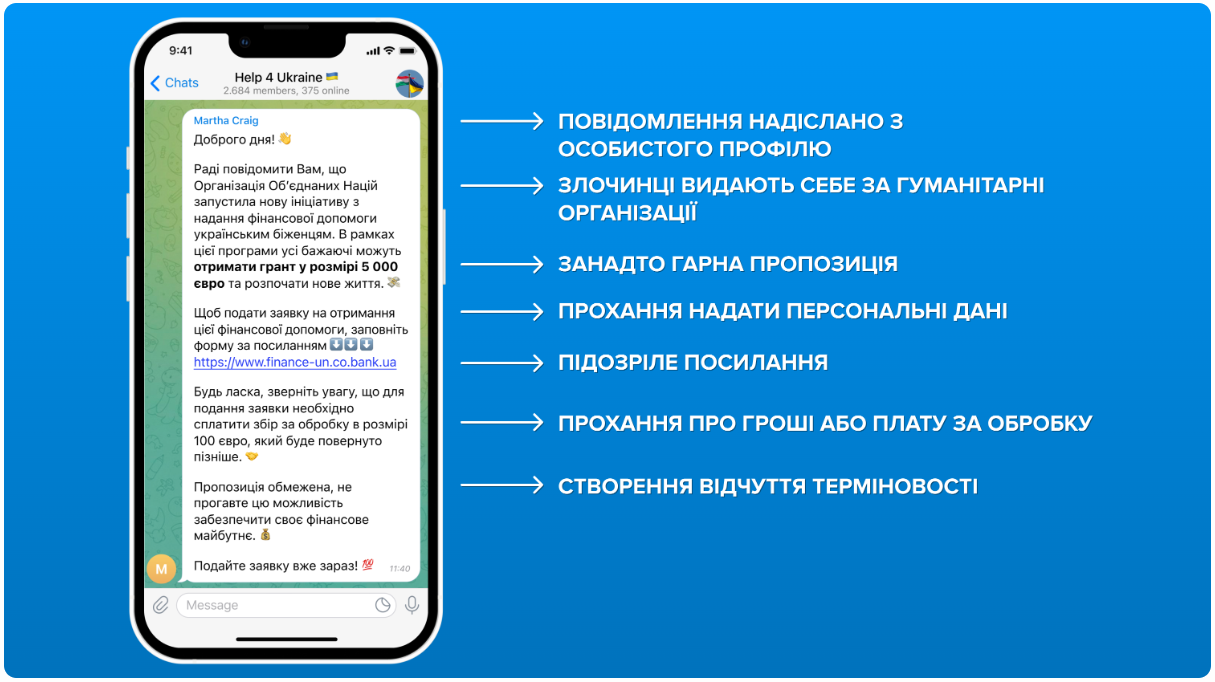
An example of fake financial aid with explanations from the official website of UNHCR.
How to protect yourself from fake financial aid
- Follow official sources. Use only the official website of the UN and UNHCR — they always display up-to-date information about assistance.
- Verify the information. If you receive a message about assistance from the UN or see a post, do not follow the link, but take a few minutes to check the news on other resources.
- Do not provide payment details. If you have already followed the link and the site seems official, do not provide payment information. Remember that no organization asks for CVV (the three-digit code on the card) and PIN code. And especially does not conduct any "test transactions."
And here arises another question — what to do with parents, grandmothers, and grandfathers? Many elderly people have modern phones, use messengers, and are on social media. You can take their phone away, but we do not recommend doing that.
Instead, explain to your grandmother how fraud schemes work. For example, no international organization sends assistance through TikTok, does not require payment details, and especially does not ask to transfer money to them. Agree that she will send you messages with offers, and you will critically evaluate such information and respond — whether they are scammers or not. Additionally, you can disable the ability to make online payments, automatic deductions, and international transactions on your grandmother's payment cards, or set strict limits on internet payments.
Easy online jobs from scammers
How much time do you spend daily on TikTok, Instagram, YouTube? About 3-5 hours, and all for free? Would you like to earn 2000–5000 hryvnias a day for watching and commenting on reels and YouTube videos, listening to music, rating hotels? Of course, because it's quick money with minimal effort. And scammers think so too, so they will gladly help you.
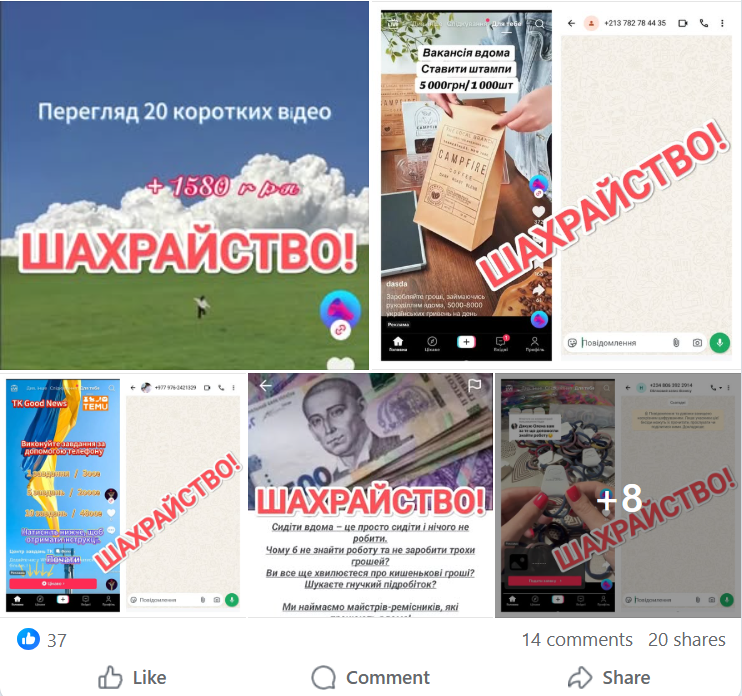
On the Facebook page "Stop Fraud", posts about identifying scammers offering such easy earnings appear regularly.
The scam scheme for easy online jobs works as follows:
- You receive messages in personal social media or messengers offering to earn 1000+ hryvnias a day through likes, comments, video views, and subscriptions. You might have seen such offers in ads and posts on social media.
- They give tasks directly in messages or, more commonly, ask you to register on their platform where you can find similar projects.
- You complete a certain number of tasks, send screenshots as proof, after which the scammers ask for your card number (just the number, without CVV and PIN) and… actually send you the earned money.
- Then they give you more tasks, and of course, you agree to complete them since you have already received money. However, you notice (or they inform you) that to access higher-paying tasks, you need to top up your balance.
- As soon as you send them your own money, they simply remove you from the group/platform, block you on all social media and messengers.
But why is this a scam, since it was indeed possible to earn from likes and comments before? From 2012 to 2018, similar services existed, mostly in Russia, but they paid about 0.05-0.5 UAH per like, 0.5-2 UAH per comment, 1-3 UAH per subscription. Comments had to be at least 300-500 characters and then go through verification. For likes, you had to watch 50-80% of the video, which also took a lot of time. So real earnings rarely even reached 20–100 hryvnias a day (and also consider the commission for withdrawing funds).
I also received offers for easy work, and once I decided to "work" with them out of curiosity. They gave various tasks, such as liking videos and completing quests, on which I earned 500 hryvnias. I could have earned more, but initially, they asked me to pay them 1800 hryvnias for the tasks. How did the story end? I took 500 hryvnias and donated them to support the Armed Forces of Ukraine! So you could say: scammers helped me do a good deed.
How not to fall for easy job scams
In 2025, services that actually paid for likes and comments either closed down or barely exist. The reason is the improvement of algorithms that now block or shadow-ban accounts for manipulation.
However, everyone wants easy money, and scammers even show a "real" balance and will send the first money. So let's remember simple protection rules:
- Easy work ≠ big money. As we mentioned, it was possible to earn from likes and comments before, but 100 hryvnias at best. For which you had to work for hours.
- You get paid for work, not the other way around. In legal work, you do not need to top up your balance, make deposits, or transfer money for access to tasks. You came to work, so they should pay you, not you. This is the same as if company owners asked employees for money to complete tasks, or HR managers charged for conducting interviews.
- Check the companies. If you are still interested in such work, check who you will be working for. If they do not tell you the name of the company, that is already a sign of scammers.
And, as we mentioned about elderly people, — limit their online payment amounts or disable online payments altogether. Even if they believe in such "work," they simply won't be able to send money to scammers. At most, they will waste their time and receive money if the scammers are still operating under the old scheme with the first payment.
Online stores with non-existent products
In recent years, the number of fraudulent online stores has significantly increased — platforms that offer products at affordable prices, then do not ship purchases, steal personal and payment data. According to the Cyber Police and the NBU, in 2024, the total losses from such schemes amounted to 833 million UAH.
Although each scammer operates according to their own scheme, we have identified key stages of fraudulent online stores' operations:
- They prepare the platform. This can be a social media page, a landing page, or a full-fledged online store. They add fake documents, guarantees, certificates, company history, and reviews. They upload real photos and videos to the catalog (taken from other stores or manufacturers' websites) or create content using artificial intelligence.
- They launch an advertising campaign. They create ads through Facebook Ads, Instagram Ads, Google Adwords, TikTok, Telegram, such as "Hurry up to buy an iPhone 15 with an 80% discount."
- They take the money. Some may require partial or full prepayment but send nothing. Others ask for card details (number, CVV, expiration date) for payment, after which they use the obtained information to withdraw money from the account, obtain loans, or sell the data.
- They disappear. Usually, such platforms exist for 1-2 weeks, after which they disappear as if they never existed: no advertising, websites, or social media. Some may actually send the first order but disappear after the customer contacts them again with a much larger sum of money.
Partially, the increase in the number of people who fell for the hooks of online stores run by scammers can be explained by the popularity of Aliexpress and Temu. And this is quite logical: they sell products for pennies, so why can't Ukrainian sellers do the same? There are also people who approach this with the principle of "200-300 hryvnias is not a big deal," meaning they are ready to make a prepayment, and if they are deceived, the money is not that significant. Thus, scammers can carry out their schemes for months, as the losses for people are small, there is no desire to write negative reviews, and no time to contact the police.
How to avoid working with a fraudulent online store
Ensure the reality of the company/seller and the availability of the product, analyze prices, and use verified payment methods (cash on delivery, Prom payment, official WayForPay and LiqPay). In general, you need to critically approach offers at the lowest price — no decent seller will work at a loss.
Let's take a closer look at ways to protect yourself from fraudulent schemes with online stores:
- Check the registration date. We have already discussed the WHOIS service, so we recommend using it to check the domain. Of course, there are real new web resources, but it is still better to buy products from platforms that have existed for 6+ months.
- Check the security. Click on the settings icon next to the URL and check whether the connection is secure. Google Chrome even provides complete data about the web resource without going to other services; just click on "About this page." You can also use the EMA service to check for fraud and malware.
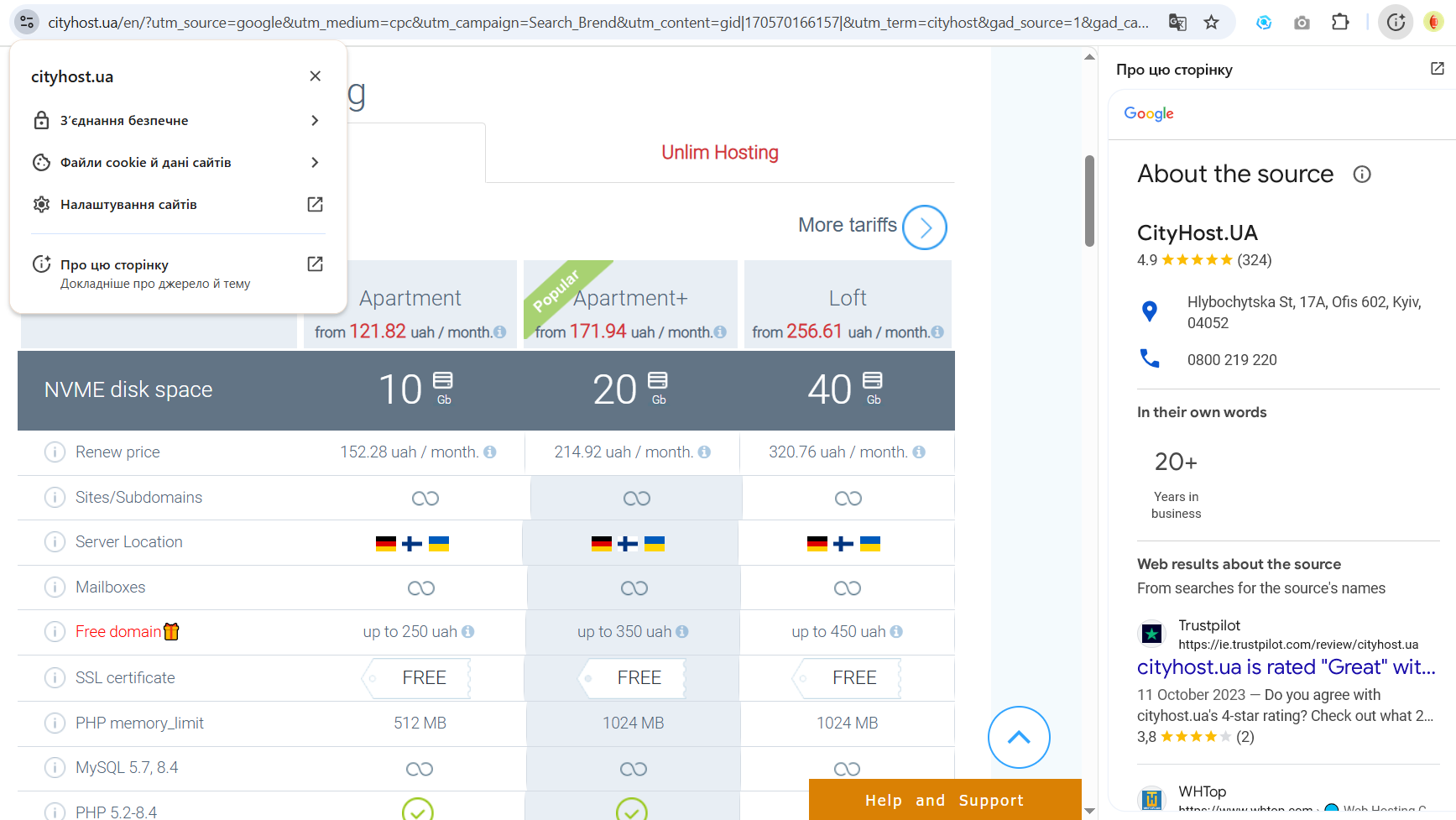
An example of checking our website page for affordable hosting rental through Google Chrome.
- Analyze the information. Find out if the address listed on the site actually exists and what is there. Ask about the sole proprietorship, EDRPOU, and certificate if they are not specified in the online store. And be sure to check through the Ukrainian Bureau of Credit Histories or the Ministry of Justice of Ukraine.
- Use a virtual card. Never use credit cards for payments; otherwise, you may not only lose your own money but also get into debt. In Monobank, PrivatBank, PUMB, and other banking organizations, you can create a separate Internet card. It is designed for purchases and payments online, issued and serviced for free, with no physical plastic. Keep a small amount of money on it, or even better — transfer from the main card directly before purchasing the product. It will allow you to lose only a small amount of money in the worst case, not all your savings on the main card.
Although you will need to spend time checking the seller, it is much better than losing money or incurring unwanted debts. If after checking you still have even slight doubts, it is better to buy the product from a verified store.
Friendly and romantic relationships with scammers
Do you dream of a person who shares your interests, listens to you, writes every day, and responds quickly to messages? But instead, you spend hours on empty conversations with people who are not your type at all? And then you receive a message from an incredibly handsome man (or woman) who turns out to be a wonderful conversationalist, and this is love for a lifetime.
Sometimes he asks for a small favor, like topping up his mobile account or borrowing some money until payday, but these are just trifles, and you go along with it. Suddenly, he gets into an accident, needs urgent treatment, feels embarrassed to tell you about it, especially to ask for money, but has no one else to help. And you are ready to help again: terrible situations happen to everyone, and he is a wonderful person and will definitely pay you back. Only after transferring the money does this "wonderful" person disappear, does not respond, and for some reason blocks you.
Such romantic scams have been known for a long time, but in recent years, they have become more frequent. For example, a resident of Prague sent a total of about 6 million Czech crowns to a fictitious Sandra Bullock, who promised to take him to the USA. In Kamianets-Podilskyi, a 19-year-old boy created a fake account of a girl on Instagram and extorted a total of 500,000 hryvnias from a military man. And in France, a 53-year-old citizen was scammed out of 850,000 dollars by a fake Brad Pitt, who initially asked for money to pass customs to send her gifts, and later — for treatment for cancer.
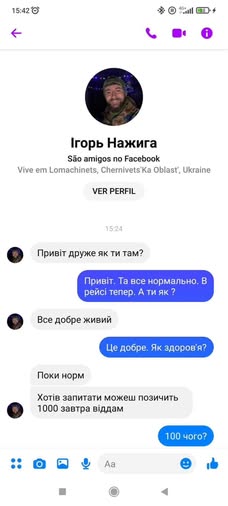
But scammers do not only target those looking for romantic relationships. For example, the secretary of the Novodnistrovsk City Council, soldier of the 107th brigade Ihor Nazhyha reported that scammers created fake copies of his profile, from which they asked friends and relatives to lend money.
How to protect yourself from romantic scammers
Although romantic scams and fraud schemes involving impersonating real people look different, their essence is the same — to extract money or personal data. Therefore, we recommend the following protection methods:
- Verify the account's authenticity. Just call the person via video chat through social media. There may be excuses like "it's inconvenient to talk," "I don't have time," etc., but this is already a sign of fraud. If a person has time and opportunity to write to you about money, they can discuss this issue with you via video chat.
- Do not send any documents. Scammers may ask for personal and payment data supposedly to arrange a package to send you a gift. However, no real person needs your passport details or photos of your bank card in private messages.
- Do not follow links. If your friend, loved one, or new acquaintance offers to go to a platform for investments, cryptocurrencies, or stocks — this could be a scam. So it is better to always check what kind of site it is, how secure it is, and what reviews are online.
- Do not send money to strangers. No matter how much your new "love" insists that they need money for a gift, a ticket, until payday, etc., do not send it — these are classic scenarios of romantic scammers.
In 2025, fraudulent schemes became more technological and plausible. They are becoming increasingly difficult to recognize, so there is no absolute protection against them. But you can minimize risks by following basic rules: check the source, do not follow suspicious links, do not provide personal information, do not make advance payments to dubious sellers, and do not send money to strangers.
And of course, always critically evaluate information, especially if it is "very beneficial" or "urgent." It is better to spend your time, seem "paranoid," than to get into trouble that you will have to deal with for a long time.