- The Fundamental Possibility of Relocating Data Centers to Orbit
- Who is Already Attempting to Move Computations to Orbit
- Economic Sense
It should be said more cautiously: they are not yet moving, but both the possibility and the need for this have already been outlined to some extent.
We can start the conversation with a few fundamentally important questions: is it technically feasible, is it justified by commercial demand, and can it become a mass market.
Most discussions on this topic begin with the lack of electricity for the operation of large data centers on Earth.
It is not so much about a lack of electricity in general, but about a lack of available capacity in the right place. According to EPRI, data centers currently consume about 4–5% of the electricity in the U.S., and by 2030, their share could rise to 9–17%. In Virginia, the largest data center market in the U.S., it already exceeds 20%, and by 2030, it could reach 39–57%.
This is particularly evident in Ireland. The share of data centers in electricity consumption there has risen from 5% in 2015 to 23% in 2025 — more than all urban households in the country, which account for 18%. As a result, Ireland has introduced special rules for new data centers: they must provide their own or nearby energy generation or storage, proportional to the capacity they want to draw from the grid, and at least 80% of their annual consumption must be covered by additional renewable energy projects in the country.
To connect a new data center, high-voltage lines, substations, transformers, and other equipment are needed, which cannot be scaled as quickly as a server park, so the problem is even more serious and complex than simply generating more electricity and feeding it into the existing grid. Restrictions are already affecting the architecture of large online services: in August 2026, it became known that Amazon, as part of the Region Flex project, plans to rely less on overloaded large AWS regions and distribute its systems more widely among smaller ones. According to internal company documents, one of the factors was indeed the limitations of available electrical and data center capacity; Amazon's Dublin footprint was planned to be reduced by approximately 40%.
At the same time, there is demand.
AI has created a measurable and real market: computing power itself has become an expensive commodity. H100s are currently rented for a few dollars per GPU-hour, new B200s for about $6–10 depending on the provider and conditions (you can read more about prices here). A constantly loaded GPU can thus sell computations worth tens of thousands of dollars per year. But we have already discussed above why the growth of capacities is limited by needs and the speed of infrastructure growth.
Computing capacities can today be scaled faster than the energy infrastructure needed to power them. This gap forces the industry to seek increasingly unconventional solutions — from self-sustaining power plants and locating data centers near energy sources to the idea of relocating some computations to orbit.

Read also: How the IT industry learned to think in terms of disasters: resilience built into architecture
The Fundamental Possibility of Relocating Data Centers to Orbit
We know how to launch spacecraft, place satellites into orbit; there is nothing new here.
It is fundamentally possible to relocate computations to space right now. Servers can be powered by solar panels, data can be transmitted via radio or optical communication, and heat can be dissipated using radiators. This is not a significant technical problem in itself, as long as it does not concern scale.
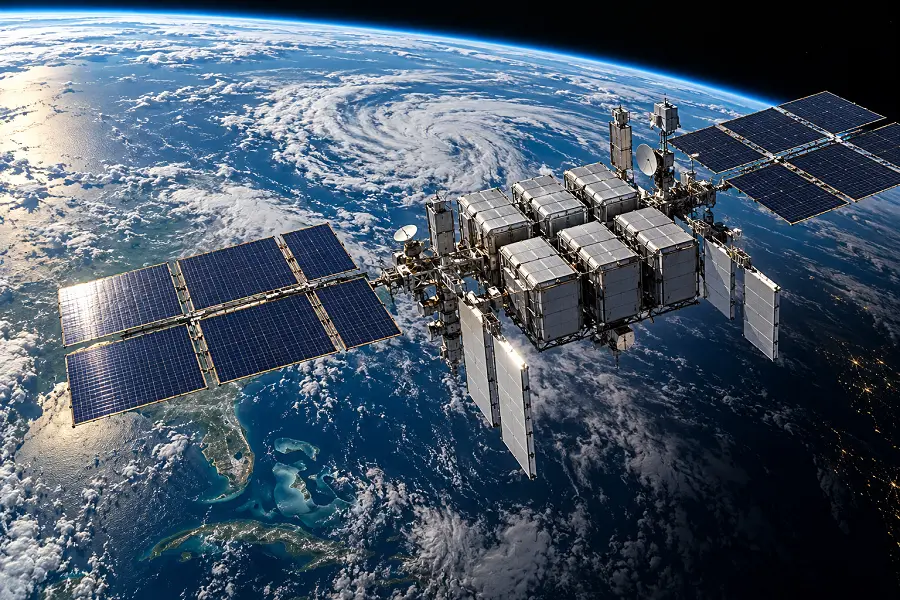
For an orbital data center with a capacity of 1 MW, one model requires about 5,640 m² of solar panels and 2,500 m² of radiators. Together with energy storage and other systems, this results in approximately 34–59 kg of equipment for each kilowatt of IT capacity. Calculations
Cooling is particularly complex. Despite the low temperature of space, there is no air or water in a vacuum through which heat can be transferred. It must be radiated through large external radiators. Large-scale systems of this type for data centers have not yet been demonstrated. Here is a discussion about it — GAO.
Additionally, there are costs associated with launching, limited bandwidth for communication with Earth, and the complexity of repairing and replacing equipment.
Who is Already Attempting to Move Computations to Orbit
Axiom Space established an experimental computing module on the ISS in the fall of 2025, and in January 2026, launched two separate nodes of an orbital data center. They are primarily intended for processing and storing satellite data without the need to constantly transmit it to Earth. In the future, Axiom plans to scale the system from kilowatts to megawatts of computing power.
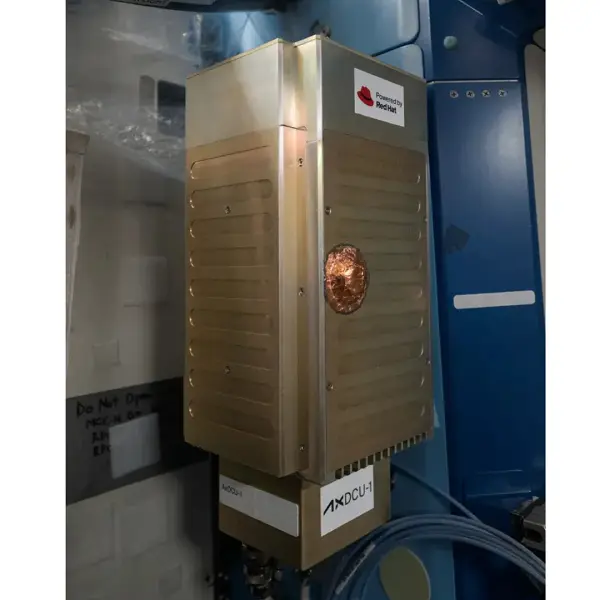
Experimental computing module AxDCU-1 by Axiom Space aboard the ISS. Photo: Axiom Space.
Another approach is being explored by Google within the Project Suncatcher. The company proposes creating groups of small satellites with their own TPUs, solar panels, and fast optical channels between them. On October 1, 2026, Google, together with Planet, launched the first prototype (there is a launch video) and established communication with it. It aims to test the operation of TPUs in the conditions of space flight, particularly under radiation and temperature fluctuations. Testing of optical communication between two satellites is planned for 2027.
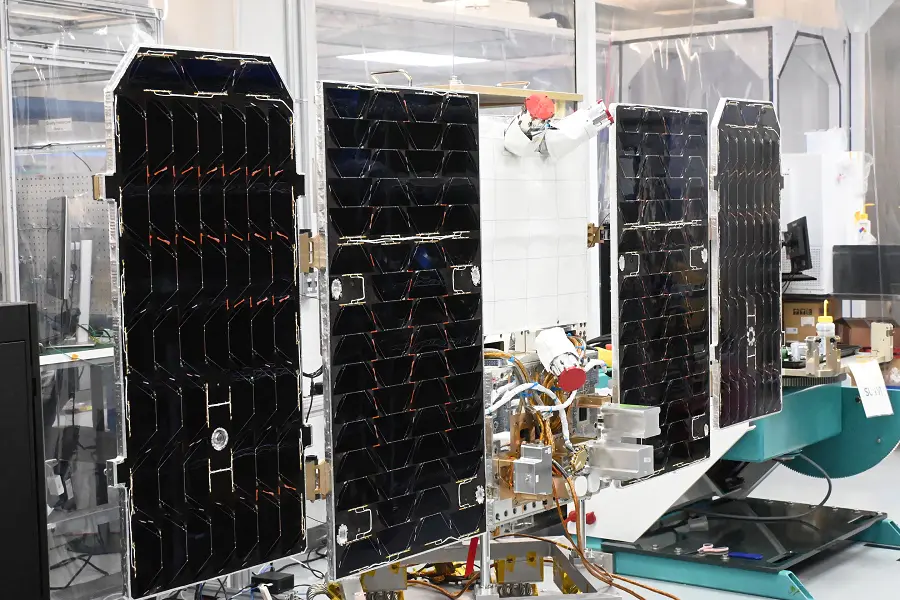
Project Suncatcher prototype indoors at Planet Labs in San Francisco. Credit: Planet Labs PBC.
The most ambitious plan belongs to SpaceX. In January 2026, the company submitted an application to the FCC to create an Orbital Data Center system with potentially up to one million satellites at altitudes of 500–2000 km. This is not yet an approved plan for building a million devices but a regulatory application for a possible future system.
Thus, all three stages of technology development currently exist simultaneously: small computing nodes are already operating in orbit, Google has begun an experiment with a distributed AI cluster, and SpaceX is planning infrastructure of a completely different scale. However, as we can see, although the testing of individual elements that will help organize future data centers has already practically begun, there is still a long way to go to a true orbital computing center.
Read also: 6G — the next technical level of wireless communication
Economic Sense
Physically, an orbital data center is possible, but its economic competitiveness has not yet been proven. For most common tasks — from website hosting to corporate application operation — terrestrial infrastructure remains simpler and cheaper to maintain.
The most realistic early scenario is processing the data that is collected directly in space, so that only the final result is sent to Earth.
Here is the work Orbital Data Centers: Spacecraft Constraints and Economic Viability, from which you can form your own impression.
Simply put, the conclusion of the work is as follows:
orbital data centers are technically feasible, but as a replacement for conventional terrestrial data centers under current conditions, they are economically unviable.
The authors essentially test the popular argument: “there is a lot of solar energy in space — let’s relocate AI data centers there.” They show that cheap/accessible energy alone does not solve anything. It is necessary to simultaneously solve the problem of the mass of solar panels and radiators, launching, communication with Earth, equipment lifespan, and its loading.
Particularly telling is their calculation of 40 kg of equipment per 1 kW of IT capacity. To compete with a terrestrial data center, the launch + manufacturing of a space system would need to cost approximately $250–1000/kg. The public price of launching a Falcon 9 is already 3.4–13.5 times higher — even before accounting for the cost of the satellite, communication, operation, etc.
However, the work does not claim that orbital computing is economically unprofitable. The details of the conclusion are somewhat different:
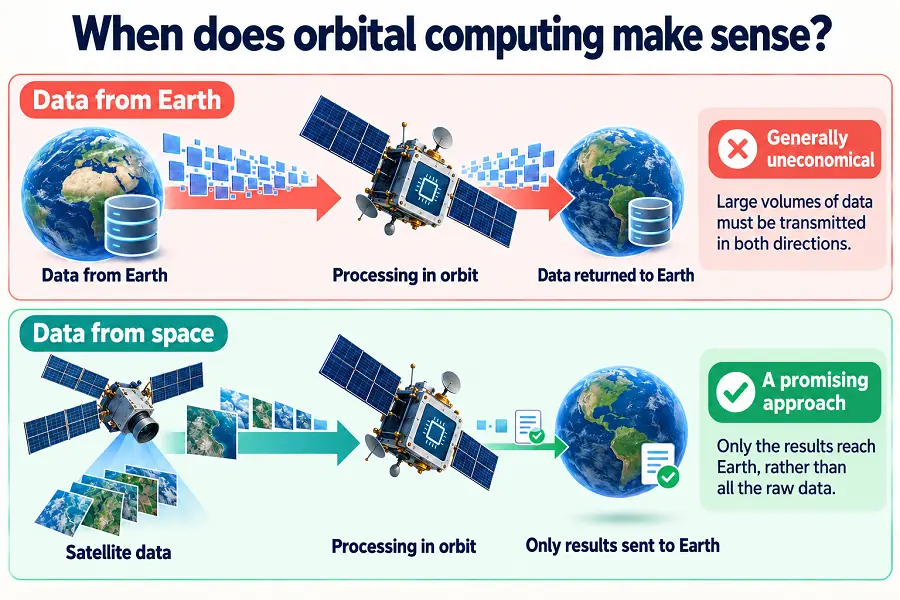
Earth data — space — compute — Earth — mostly unprofitable.
Space data — space compute — small result — Earth — yes, it’s worth a try.
For example, a satellite takes a huge number of images. Instead of transmitting all raw data to Earth, an orbital computer can find fires, ships, clouds, or needed objects and only transmit the result. Here you save on bandwidth, and computations in space begin to have their own economic advantage.
If the data is already on Earth, it is usually more reasonable to process it here: depending on the load, you can rent a VPS-VDS or dedicated server, without the costs of transmitting information to orbit and back.
The first orbital data centers, if they truly form as a separate industry, are likely to be not data centers from Earth relocated to space, but infrastructure for data that is already generated in space.
However, to move computations from Earth to space, a number of technical issues still need to be resolved: reducing launch costs, possibly reducing the mass of what we are launching (panels, equipment, etc.), and solving the cooling problem. So far, this problem has not been definitively resolved, but if companies are willing to invest in artificial intelligence and related research, they can also invest in how to make space computing cheaper.