

- What is green hosting
- Why is a website on green hosting needed
- Does green hosting affect website ranking
- How to distinguish green hosting from greenwashing
- How to optimize a website on green hosting
Data centers around the world currently consume about 1.5% of all the electricity on the planet, and by 2030 this figure will increase to the level of Japan's annual consumption. And in 2026, for website owners, data centers powered by renewable sources — this is not a marketing slogan, but primarily a responsibility for the environment. We at Cityhost understand this, so we consciously keep part of our capacities in green data centers. Therefore, we decided to explain in more detail what green hosting is, as well as share our own experience and show the process of checking our website for "greenness," which you can replicate on your own web resource.

What is green hosting
Green hosting is a service provided by a hosting provider that operates its server park in data centers powered not by fossil fuels, but by renewable sources. In combination with energy-efficient equipment, this significantly reduces the negative impact on the environment.
But this is not just another item in the catalog alongside virtual hosting, VPS, or dedicated server. The emergence of this service is driven by a very specific reason: according to IEA data, electricity consumption by data centers is increasing by about 12% annually, and by 2030 it will double to ~945 TWh. At the same time, data centers are not green by default: renewable sources provide only about 27% of the electricity they consume, with coal still being the largest source — about 30%. That is why the transition to renewable energy is a conscious and valuable choice for the provider.
A logical question arises — how does a data center become green? When thinking about renewable energy sources, one immediately imagines building giant solar fields or wind turbines directly on the roof of the server room. In practice, this is inefficient: the roof of even a large data center will provide at best kilowatts of power, while the facility itself consumes megawatts.
That is why data centers provide green hosting through other methods:
- Power Purchase Agreements (PPA). The data center signs a long-term contract with a clean energy producer and guarantees to purchase all or part of its output at a fixed price. This does not mean that these electrons will physically reach the server, but it directly finances the construction of new "green" capacities.
- Renewable Energy Certificates (RECs, Guarantees of Origin). This involves purchasing certificates of energy origin that finance the development of renewable energy in the region. In fact, the provider buys confirmation that somewhere in the general grid, as much "green" energy has been generated as it consumes. Unlike PPAs, a certificate does not always mean an investment in a new power plant — more often it confirms an already existing "green" balance in the grid.
There is another way to ensure green hosting that the data center already physically controls — local energy-saving technologies. Modern companies use free cooling systems with outside air, reuse heat for heating offices, and closed "cold corridors" where cooled air goes directly to the servers instead of mixing with hot air.
Why is a website on green hosting needed
The main reason is the reduction of carbon footprint and negative impact on the environment. Data centers consume more and more electricity, and choosing a provider based on renewable sources directly reduces harm to the environment. Other reasons include compliance with the requirements of European partners regarding sustainable development and increased trust in the brand among environmentally conscious audiences.
Reduction of carbon footprint
Data centers are one of the few sectors where emissions are not decreasing but are increasing. According to IEA estimates, by 2030 they will account for about 1% of global CO₂ emissions. And while most industries are gradually decarbonizing, DC consumption is only accelerating due to the development of artificial intelligence. Every website, application, or cloud service you use runs on servers that consume this energy.
Switching to green hosting is the most direct way for a website owner to help address this issue. You cannot single-handedly change the energy landscape of an entire country, but you can choose a provider whose capacities are powered by renewable sources. The operation of the site will not change, but your digital presence will become more responsible.
Compliance with European Union requirements
If you work with clients or partners from the EU, the environmental sustainability of your infrastructure may become a requirement, even if your business is registered in Ukraine. From March 18, 2026, the EU has the Omnibus I Directive (Directive (EU) 2026/470), which updated the sustainability reporting rules under CSRD. Now mandatory reporting applies only to large EU companies — those with 1000 employees and over €450 million in annual turnover.
This directive does not directly obligate Ukrainian companies, but there is an indirect mechanism at play. Large European clients who fall under CSRD must report on emissions in their supply chain (Scope 3), including the emissions of their contractors and suppliers, including Ukrainian ones. So if you provide services to European businesses, you may be asked for data on your own carbon footprint. And green hosting will be a small but real contribution to this reporting, demonstrating your serious approach to the issue.
Improvement of brand image
Environmental sustainability has become a factor influencing consumer choice. This was confirmed by PwC in the 2024 Voice of the Consumer survey, which covered over 20,000 consumers in 31 countries. According to its results: 85% of respondents stated that they personally feel the effects of climate change in their daily lives, and 80% are willing to pay for products produced in accordance with sustainable development principles, on average 9.7% more than the usual price.
For you, this means that mentioning green hosting or environmental policy on your website is not empty marketing, but a signal that part of the audience truly values. This is especially true for brands whose customers are attentive to environmental issues. At the same time, claims of sustainability should only be made when there is a real choice of a green provider behind them, not just nice words, otherwise, you may fall into greenwashing.
Also read: How to create a target audience profile: sharing our experience
Does green hosting affect website ranking
No, there is no direct and confirmed impact in either Google, Bing, or artificial intelligence systems. No official documentation from Google Search Central mentions the "greenness" of a site or hosting as a ranking signal. In Understanding Google Page Experience, it is explicitly stated: there is no separate "page experience" signal — ranking systems look at a combination of factors, among which are Core Web Vitals.
Even Core Web Vitals is a confirmed but weak factor. John Mueller from Google has directly warned that one should not get fixated on ideal technical metrics for the sake of ranking alone. This is an interesting technical challenge, but it will not significantly boost search positions.
With other search engines, including Bing, and artificial intelligence, the situation is similar: there are no official "green" signals. Instead, systems like ChatGPT, Gemini, or Claude cite sources based on the authority and reliability of the content. In this case, E-E-A-T is more important for search engines than the "green" label of hosting.
Important! Some websites and social media periodically feature articles claiming that "energy efficiency will become a separate ranking factor in 2027" or "Google's algorithms are already penalizing energy-intensive sites." As of July 2026, this has not been confirmed by any official source and seems more like marketing speculation from industry blogs rather than a concrete fact. If the situation changes and search engines indeed start paying special attention to energy efficiency, you will definitely find out about it in our blog and Telegram channel.
How to distinguish green hosting from greenwashing
Greenwashing is a marketing tactic where a company invests more money in creating a plausible image of its environmental sustainability than in concrete steps to protect the environment. To understand whether a provider truly offers green hosting rather than engaging in greenwashing, check for the presence of ISO 14001 or EMAS certifications, contracts for the purchase of renewable electricity (PPA), annual audits, and public reporting.
For additional verification, there are specialized free services that we checked on our Cityhost website.
Checking the website on The Green Web Foundation service
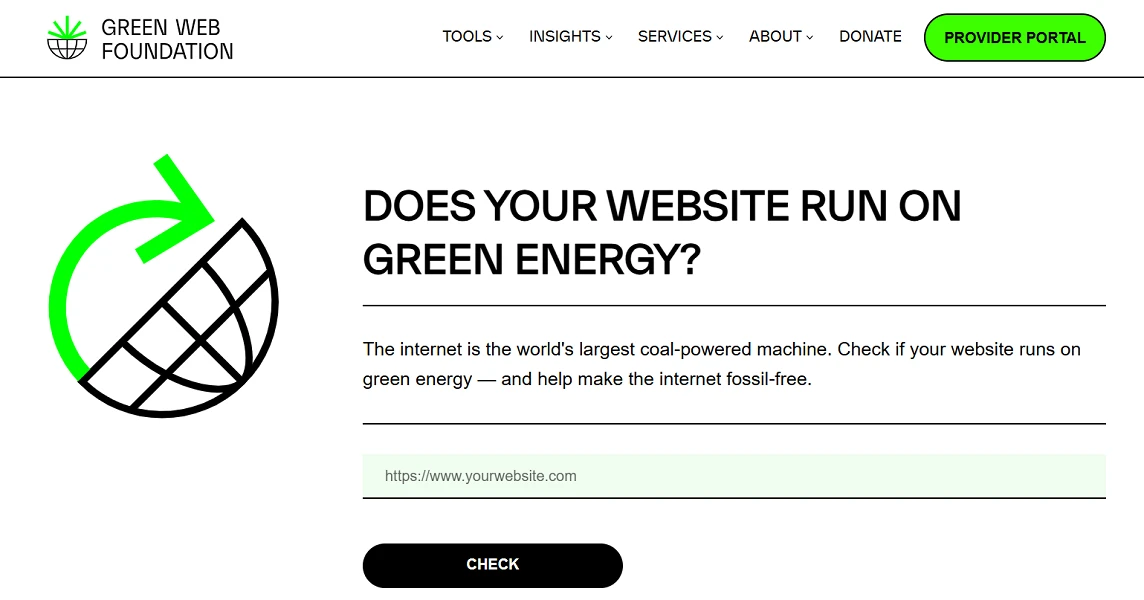
For example, let's go to the website of the main global auditor of internet ecology and use their Green Web Check tool. No registrations or long waits — just enter the domain, click Check, and get the result.
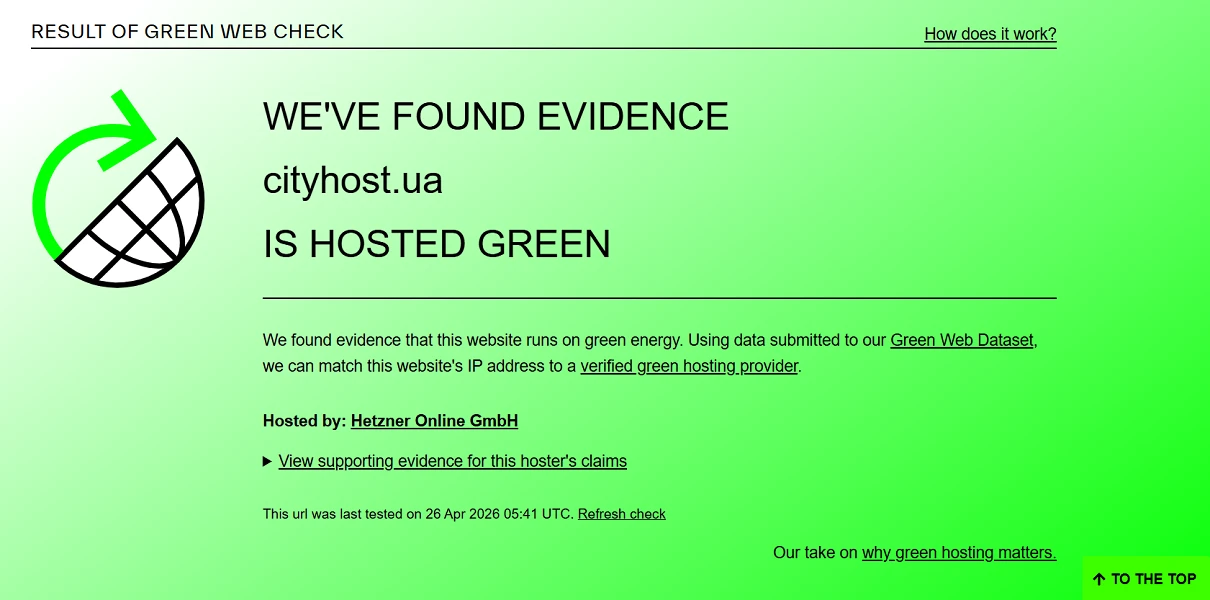
For example, the service gives the following conclusion about Cityhost: "We found evidence that this site is powered by green energy." This and the following translations are automated, so we add a screenshot in the original.
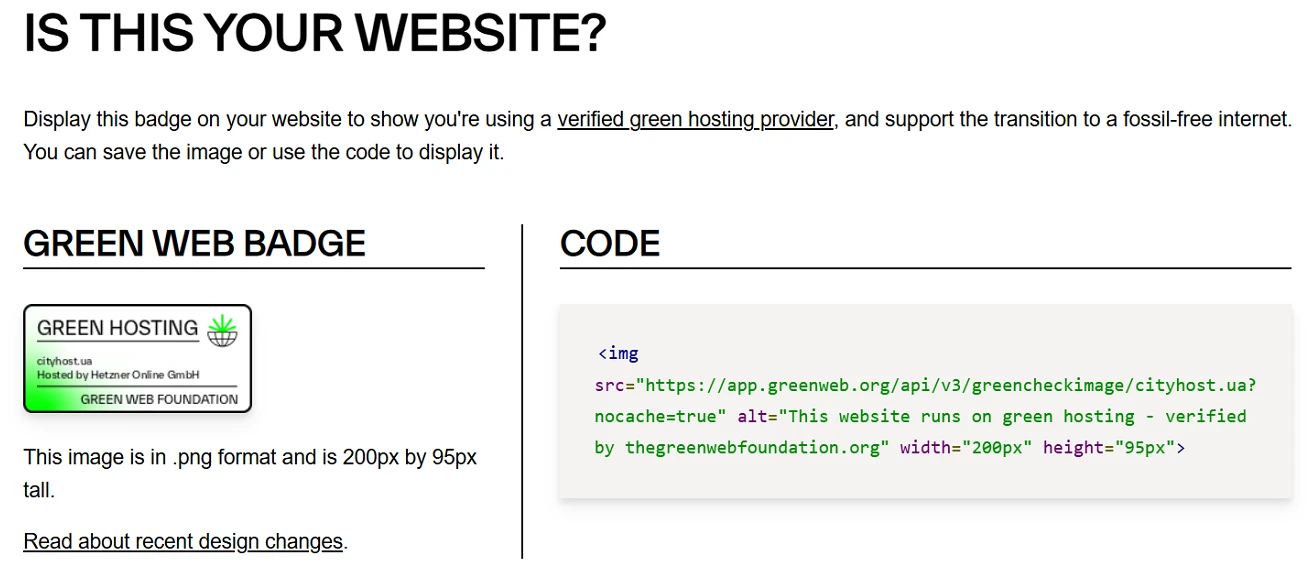
You can also check your site and obtain a Green Web Badge. As The Green Web Foundation itself states, this badge shows that you are using the services of a verified green hosting provider and supporting the transition to a fossil fuel-free internet.
This result is possible because Cityhost's European capacities are deployed based on verified partners with strict environmental standards:
- Germany and Finland — Hetzner, a large German provider with its own data centers in both countries. The average PUE is about 1.13, and the German locations have EMAS certification. All electricity is 100% renewable: in Germany, it is hydropower, and in Finland, it is hydro and wind generation.
- Netherlands — Serverius data center (operating under the Kolo brand since July 2025) in Dronten. According to the site's own statement, it is CO2-neutral, powered by 100% green electricity, uses free cooling, closed cold corridors, and heat recovery.
Thanks to this structure, when you purchase virtual hosting or rent a VDS server at a European location, your site is hosted on eco-friendly equipment.
Our observations during the check! Green Web Check determines "greenness" not by the building's address but by the site's IP address: it checks it against a database of verified green providers GWF. Therefore, for web resources on European capacities, you will see the infrastructure provider whose IP ranges are registered in GWF as green — Hetzner. This is not an error or substitution: this is how the tool works, and the main thing for you as a client remains unchanged — the site passes the check and receives green status.
Evaluating the website through Website Carbon Calculator
Website Carbon Calculator is a service that allows you to assess the amount of carbon dioxide (CO₂) emissions generated during the operation of a specific page of a website. It was created by Wholegrain Digital so that anyone can freely check any web resource and raise awareness about the ecological footprint of the internet.
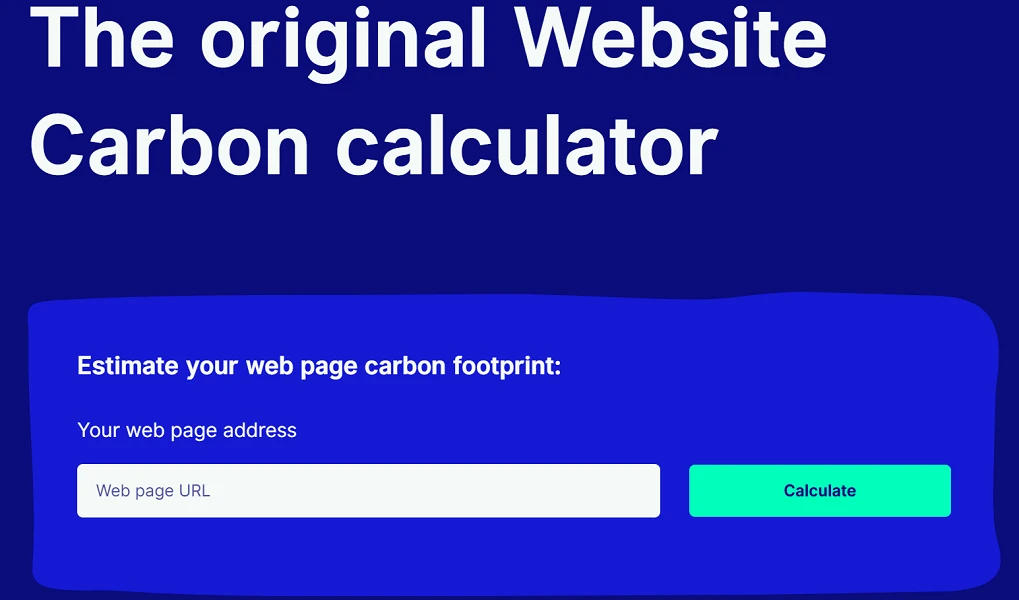
To use it, go to the main page websitecarbon.com, paste the link, and click Calculate.
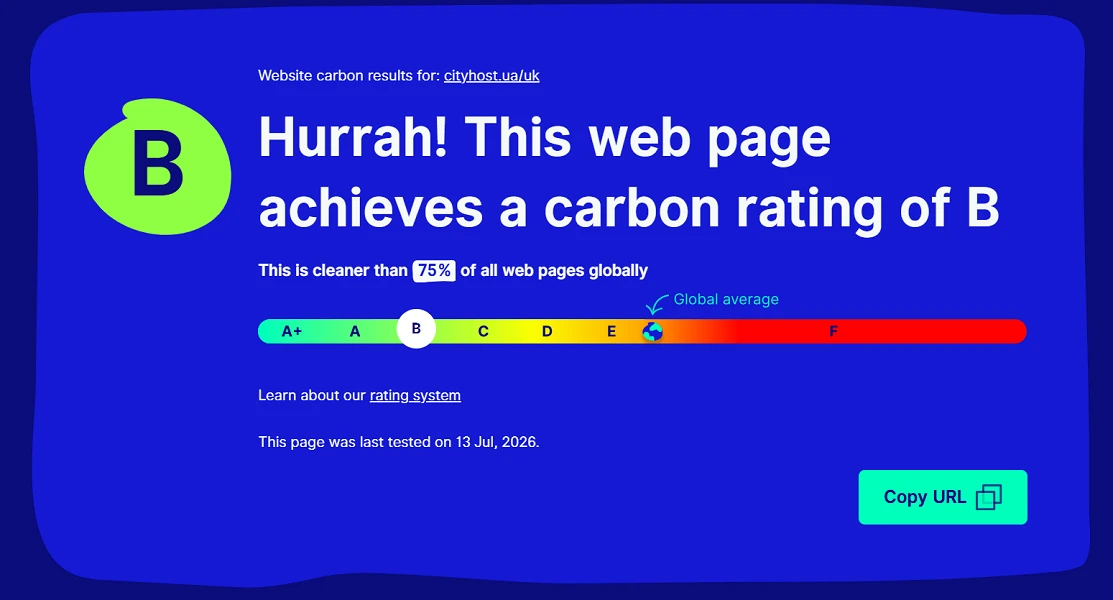
After 30-60 seconds, you will receive the result. For example, Cityhost's homepage received a grade of B. As stated on the service itself: "This page looks cleaner than 75% of all web pages in the world."
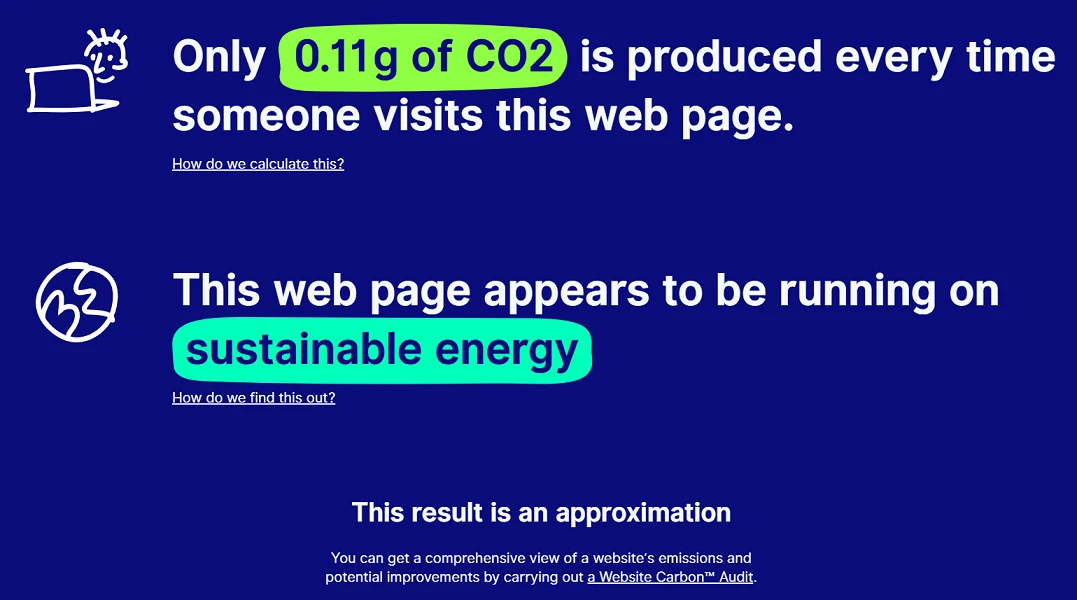
If you scroll down a bit, you will see several interesting facts based on your site's results. For example, Website Carbon Calculator indicates that "only 0.11 grams of CO2 are created every time someone visits this webpage" and "it seems this webpage operates on sustainable energy."
Important! Website Carbon Calculator and other similar services provide tools for assessment, not precise measurements. They work through the volume of data transmitted and the average "carbon intensity" of the power grid, so the result is an approximation, not a lab measurement. This is not a reason to ignore the numbers, but a reason not to treat them as absolute truth.
How to optimize a website on green hosting
Having green hosting is good, but to truly have a "green site," it needs to be additionally optimized. A lighter page means less data transmitted, and thus less load on the data center's processors. The side effect of such optimization is a lower carbon footprint for your specific site.
Even minimal actions in addition to using green hosting can significantly improve the results of your online project. For example, a study by Google in partnership with Deloitte, which covered 37 major brands and over 30 million sessions, showed that improving loading speed by just 0.1 seconds increases retail conversion by 8.4%, and in the travel segment — by 10.1%. The agency Portent analyzed over 100 million page views on 20 sites and recorded remarkable results: among e-commerce sites, a page that loads in 1 second converts 2.5 times better than a page with a 5-second load time, and among B2B sites, the difference is 3 times.
We have already detailed specific metrics of website speed and how to measure them. Now we want to highlight several points that will help reduce the load on servers, and accordingly, the negative impact on the environment:
- Update media formats. Convert images to WebP or AVIF. According to controlled tests, WebP weighs about 30% less than JPEG, and AVIF — almost half, without noticeable loss of quality.
- Set up lazy loading. Images below the first screen should load only when the user scrolls to them on the page.
- Conduct an audit of third-party scripts. Remove outdated marketing pixels, inactive chat widgets, and analytical systems.
- Use modern fonts. Switch to WOFF2 format and remove characters (glyphs) that you do not use on the site.
Thus, the environmental sustainability of a site is not a myth or a trend for the sake of trend, but it is also not a hidden ranking factor that will suddenly elevate all pages to the top. This is primarily about responsibility: green hosting reduces your site's footprint, and basic optimization makes this contribution even more noticeable. None of these actions will change your positions overnight, but together they make your digital presence more conscious, and the internet a little cleaner. And the more website owners choose this path, the more it will matter.