- What is 6G and how does it differ from 5G
- Where will such speed in 6G come from
- When the network becomes a sensor
First of all, for those who don't know (and I, for example, didn't know until recently) — G — stands for generation. In the case of communication, it refers to the rules by which a mobile network operates.
A phone is a small receiver and transmitter, and it communicates with a base station that sends data further into the network. When we open a website, the mobile network connects us to the infrastructure where it operates. This can be a regular website hosting or a virtual server — depending on the needs of the site. The request goes there via the internet, and the content of the page is returned to the phone.
The connection with the base station is the first segment of this path, the capabilities of which change with the emergence of new generations of G.
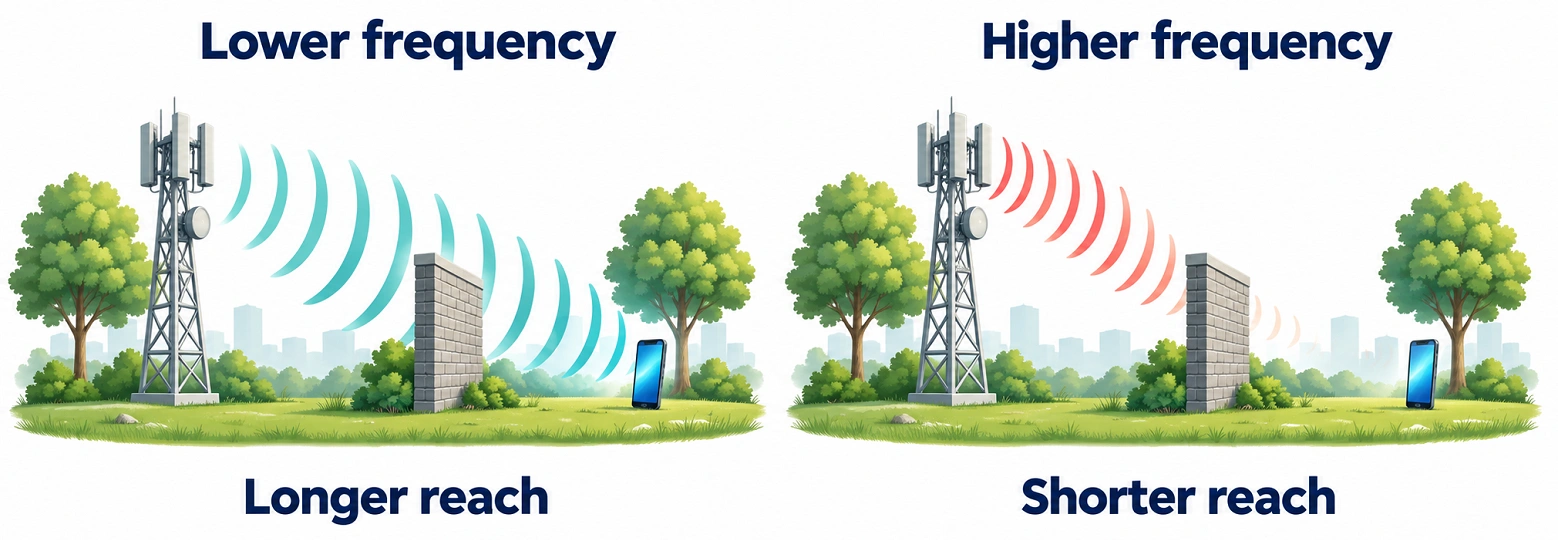
For communication between the phone and the base station, radio waves of different frequencies are used — different segments of the radio frequency spectrum. Frequency is measured in hertz: for example, 700 MHz, 3.5 GHz, or 30 GHz.
The concept of spectrum also matters — it can be very simplistically imagined as the space in which the network transmits data, and the allocated frequency band as the width of this space. The wider the available band, the more data can be transmitted in the same time — that is, the higher its bandwidth. At higher frequencies, it is easier to find wide free bands, but the signal itself has a harder time overcoming large distances and obstacles, while at lower frequencies, coverage is better, but the bands will be more "cluttered."
Also, the difference between generations is that this technology "can":
- 1G — is simply voice transmission over a radio channel.
- 2G already encodes voice, allows for slow data transmission, and sends text messages — SMS.
- 5G restructures the radio interface and network architecture so that very different tasks can be solved simultaneously: high traffic, low latency, a huge number of devices, etc.
In short, initially, new Gs meant a transition from analog voice communication to digital data transmission. And then each generation changes how much data, how fast, with what latency, and for how many devices the network can transmit simultaneously.
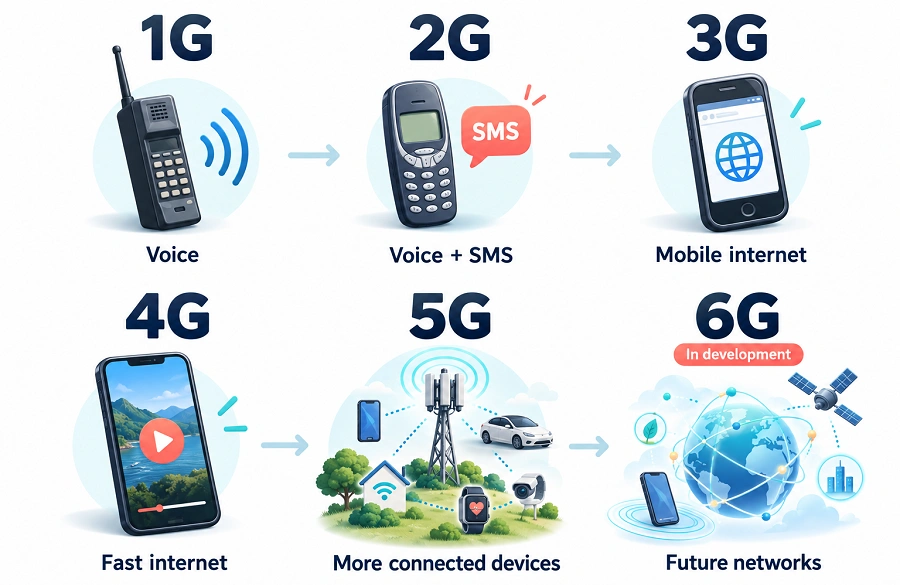
We all probably remember how the transition to 4G and then to 5G occurred. Now it's time for the sixth generation.
What is 6G and how does it differ from 5G
6G — is the next, sixth generation of mobile communication. So far, it remains under development: ITU (International Telecommunication Union) calls the future system IMT-2030, and the specific technologies it will consist of are still being defined. To be honest, plans for 2030 seem somewhat overconfident to me, but we are all pushed towards such abstractions by obligations, so why shouldn't they push mobile network developers as well.
5G can already transmit a lot of data, support a huge number of devices, and provide very low latency. 6G is expected to push these characteristics further, but at the same time, new tasks are added to the mobile network.
For example, the network must not only transmit a signal but also more accurately determine the location, movement, and distance to objects — that is, partially work as a sensor. Ground mobile communication is planned to be more closely integrated with satellite and other non-terrestrial networks. A separate direction becomes the network's work with AI — both for managing the network itself and for transmitting data between devices and computing systems.
The scale is also changing. For IMT-2030, the following target characteristics are currently being considered:
- Peak speed — 50–200 Gbit/s.
- Latency — on the order of 0.1–1 ms.
- Connection density — up to 10⁶–10⁸ per square kilometer.
- Positioning accuracy — up to centimeters.
These are benchmarks for various scenarios, not a set of indicators that must be achieved simultaneously. That is, a smartphone with 6G support will not automatically show 200 Gbit/s.
Moreover, the difference between 5G and 6G is not reduced to a single number. 5G primarily expanded the capabilities of the mobile network as a means of communication. In 6G, they are trying to make the network itself a more complex system: it transmits data, determines the characteristics of the physical environment, integrates different types of networks, and increasingly interacts with computations.

Where will such speed in 6G come from
So, 200 Gbit/s. Where can they possibly come from?
Earlier, we already talked about bandwidth and channel width. One way to transmit more data in the same time is to obtain a wider channel. The problem is that the radio frequency spectrum has long been used: by mobile communication, television, satellites, radars, Wi-Fi, and a bunch of other systems. Finding a large contiguous piece of free spectrum at conventional frequencies is not easy.
Therefore, researchers are looking higher — specifically at frequencies above 100 GHz and the so-called sub-THz, sub-terahertz range. There, it is possible to obtain significantly wider channels.
And here is an important clarification: higher frequency does not automatically mean higher speed. We are interested in the ability to obtain a wider frequency band there and transmit more information through it.
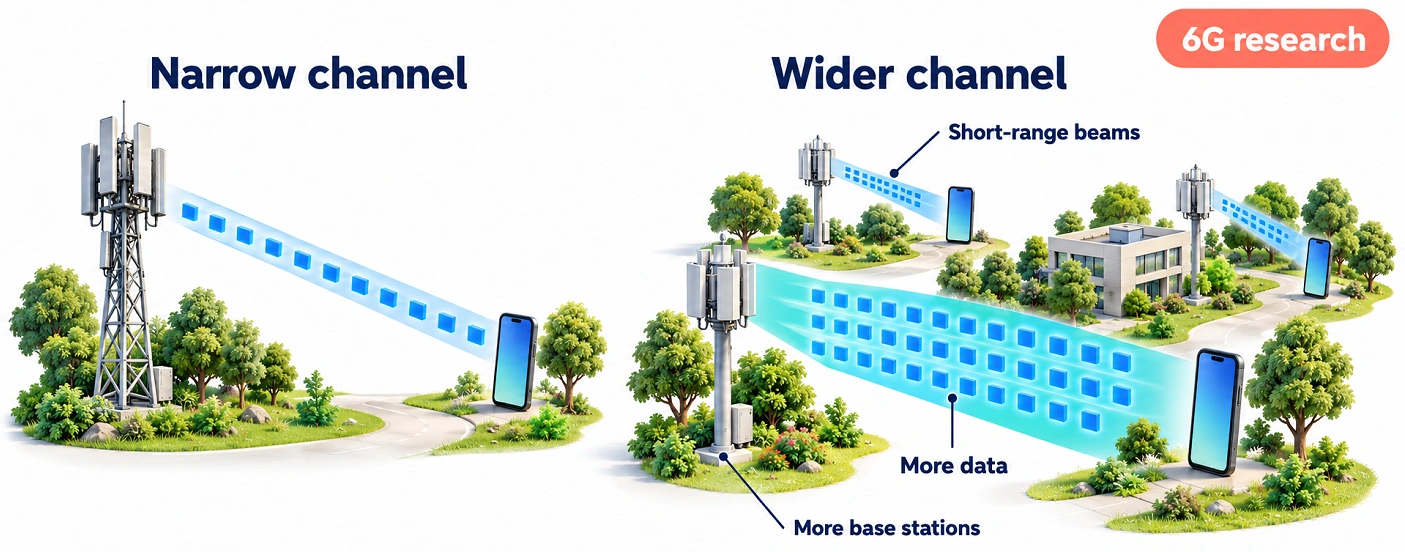
Of course, this comes at a cost. We already mentioned at the beginning: the higher the frequency, the harder it is for the signal to overcome large distances and obstacles. Therefore, such communication requires more complex antennas and, in general, a denser infrastructure, forming a directed radio beam (beamforming).
Moreover, 6G does not mean that the entire mobile network will simply move to 100 GHz or the terahertz range. Different frequencies have different advantages, so future networks are designed to use different bands.
Read also: Hosting provider, internet provider, and mobile provider — what they do and how not to confuse them
When the network becomes a sensor
And here begins, in my opinion, a very interesting part of the story about 6G.
If we poke our nose no further than Wikipedia, we learn, for example, about Chinese experiments with technologies that may become part of 6G. In the Yellow Sea, researchers tested a radar at a frequency of about 110 GHz and were able to detect extremely weak oscillations of the water surface caused by sound underwater.
Here it is worth delving a bit into the units. Hertz — is one oscillation of a wave per second. Gigahertz — a billion such oscillations, and terahertz — a trillion: 1000 GHz = 1 THz. So 110 GHz — is 0.11 THz, already the lower limit of the range that is often referred to as terahertz in studies.
And at such frequencies, a radio signal can be used not only for data transmission but also as a very sensitive sensor. We send a signal, observe how it reflects and changes, and from this, we obtain information about the physical environment.
In the case of the Yellow Sea, underwater sound causes extremely weak oscillations of the surface, and the radar above the water can see them. That is, the receiver does not even need to be submerged in water to obtain information about what is happening beneath it.
And what if we reverse this principle? Oscillations can not only be read but also deliberately created. An underwater transmitter encodes information in a sound signal, the sound reaches the surface and causes it to vibrate slightly, and the radar above the water reads these oscillations and reconstructs the transmitted data. Essentially, this creates a communication channel from underwater to the air without a surface relay.
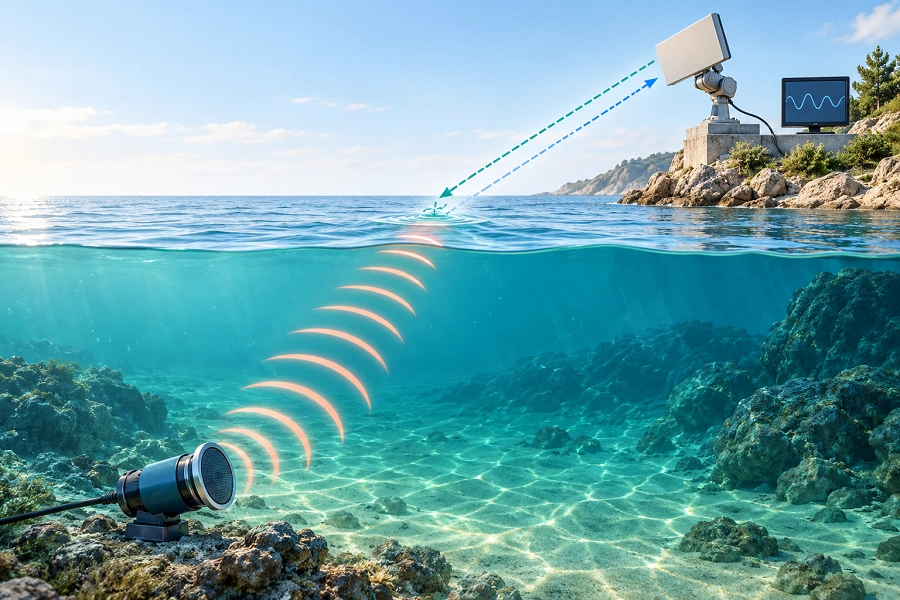
Communication and sensing begin to merge here: the same radio signal can transmit data while also providing the network with information about the physical world around it.
Read also: How the internet changed the world: TOP-10 familiar things and phenomena that might not have existed
Of course, 6G does not emerge in a vacuum. Over the last generations, mobile networks have learned to work with large antenna arrays, form directed signals — beamforming — and simultaneously serve many devices. And electronics have gradually reached frequencies in the tens and hundreds of gigahertz, which previously remained mostly the territory of specialized equipment and laboratory experiments. The shorter the wave, the smaller the antenna elements can be — and thus, they can be placed more densely in a small area and more accurately control the direction of the signal. A significant part of what 6G will be built on has already been present in 5G and 5G Advanced.
However, for 6G to work, a lot of work lies ahead. Standards, technology verification, and production are needed to allow the manufacturing of the necessary equipment at an acceptable price.
What 6G will look like in our phones in 2030 — is an open question. I still believe that plans for 2030 are somewhat overconfident.