- The History of OkayCMS: from Continuous Development to Stagnation
- Opportunities for Creating an Online Store with OkayCMS
- Testing OkayCMS: from Installing the System to Exploring Its Functionality
- OkayCMS — A Technical Dead End in 2026
In 2026, you can create your own online store without programming knowledge and huge expenses on a development team. Content management systems (OpenCart, WordPress + WooCommerce), SaaS solutions (Shopify, Horoshop), and even AI platforms (Emergent, Framer) are available to everyone. Previously, OkayCMS could confidently be included in this list of the best tools — a completely free system for creating and managing e-commerce websites.
However, the lack of new versions, old blog articles, broken links, and mentions of web resources on Russian domain names not only repel users from this system but also raise concerns about whether it is safe to use at all. I decided to check this myself, so I downloaded the necessary files from the official website, installed, and tested the system. Based on this information, I created a detailed review of OkayCMS, discussing its functionality and reliability.
The History of OkayCMS: from Continuous Development to Stagnation
The content management system OkayCMS was created by Vitalii Vladov. In 2015, he managed a web studio specializing in the development of online stores, but he was troubled by the instability of existing tools. For example, the studio worked with ShopCMS and SimplaCMS, but their creators simply stopped releasing updates. Thus, the team came to create their own product, and already in December 2015, the release took place.
In the first three versions, the team earned by selling licenses, which at that time cost $295 for one domain. In 2021, it was decided to release the fourth version with a new monetization model: the system is available completely free of charge, and revenue is generated from the sale of additional modules and templates in the marketplace. At the time of writing this article, 207 modules are available on the official website: free (some already installed, some need to be downloaded manually) and paid (from 109 UAH for "Payment acceptance via the Platon payment system" to 5250 UAH for "Integration with the accounting system Dilovod.ua").
A logical question arises: why did I even mention the stagnation of the platform if OkayCMS is developing and has already released 4 versions? Here, I suggest considering a set of points that I found while studying the system:
- the last version (4.5.2) was released on December 19, 2024, after which there were no updates;
- on GitHub it is stated "Copyright 2015-2024 OkayCMS", and after that, there is no activity;
- the last entry on the website (sections for developers and website owners, knowledge base, news) is dated December 19, 2024;
- the official Facebook page was last updated in March 2024, YouTube — May 2024, Twitter — September 2019 (all links are indicated in the footer okay-cms.com);
- the link to the forum does not work at all;
- the "Reviews" section still lists Sergey Koksharov's site as devaka.ru.
At the same time, the Telegram group remains quite active: 583 people, constantly new messages, and the moderator quickly responds to questions. Plus, there is a module group, which is also constantly updated. So it turns out that the product seems not dead, but it is no longer growing and does not want to grow publicly.
Opportunities for Creating an Online Store with OkayCMS
Despite the lack of public activity and product updates, the system works, and hundreds of people use its capabilities. Moreover, the online stores listed on the official website's "Examples" page are operational and actively developing. Among them are platforms such as the official merchandise store of the esports organization Natus Vincere (NAVI), the official dealer of German power tools Machtz, and many others.

That is why I suggest taking a closer look at OkayCMS's functionality:
- intelligent filters — AJAX filtering allows store visitors to quickly select only the necessary products by brands, prices, technical specifications;
- one-page ordering — the cart updates without reloading the page, minimizing the number of drop-offs at the last stage of the sales funnel;
- pre-installed modules — the system already includes such additions as integration with Hotline, sliders, FAQ, support for Nova Poshta, payment via LiqPay and WayForPay, exporting products to Rozetka;
- multilingualism — the system supports the creation of multilingual websites and the use of different currencies;
- commercial blog — besides information about article updates, the number of comments, reading time, convenient content, the author's page with bio and links to social networks, there is an option to link products from the catalog to publications;
- SMARTY template engine — convenient change of template settings and visual appearance of the site without interfering with the code;
- meta-tag automation — you can create templates for automatic generation of Title and Description for thousands of category and product pages;
- AI integration — in version 4.5.2, which is the latest at this time, the functionality for selecting ChatGPT for generating unique product descriptions and blog texts directly from the store management panel has been added;
- SEO filter — creating unique landing pages for low-frequency queries based on filtering parameters (category, brand, specifications).
For large online stores, such functionality will generally be insufficient, but for small and medium businesses, it is quite enough. Key tools are available for free immediately after installation, plus you can later purchase modules to expand functionality. By default, a standard theme is included, but premium options can also be purchased for 3000–6000 UAH.
Also read: Faster, Better, More Efficient: Sales Automation in eCommerce
Testing OkayCMS: from Installing the System to Exploring Its Functionality
I decided to test the content management system in a local environment. To do this, I installed the free software XAMPP, launched the Apache and MySQL modules. You can do this with other software or test directly with a hosting provider.
- Launching an Online Store on OkayCMS
- Completing Training on Website Management
- Basic Settings of the Online Store
- Design Settings for the Online Store
- Managing Products in the Online Store
- Setting Up Search Engine Optimization for the Online Store
Launching an Online Store on OkayCMS
If you haven't decided on a hosting provider yet, I recommend using Cityhost's services. First, create an account, then check the domain name for availability and register a free option, after which you can choose a hosting plan (at first, it is enough to buy virtual hosting Apartment, then you can switch to a plan with more resources, VPS, or a dedicated server).
Once you complete the registration process, go to the "Hosting 2.0" panel → "Management". Next, go to the "Sites" tab → "Add Site" and specify the registered domain. After this, a folder for files will be automatically created on the server.
Now we proceed directly to uploading the OkayCMS files. This can be done from the official website by clicking the "Download" button in the header of the web resource.
Go to the Cityhost panel and open the "File Manager". There, find your site's folder and delete the standard index.php file. After that, click "Upload File" and select the install folder from your computer (this is the archive you downloaded; all files will be in this folder).
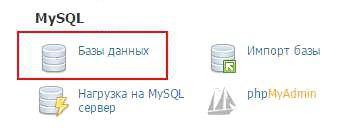
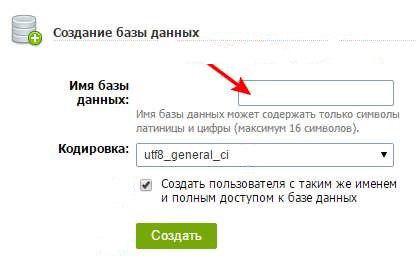
Now you need to create a MySQL database. To do this, in the Cityhost panel, select "Hosting 2.0" → "Management" → "MySQL" → "Databases". There, click "Create Database", specify the name, and choose the default encoding. Here, create a database user and be sure to save the username and password.

Finally, we can proceed to install the system. In the browser, open http://yourdomain/install/. I then installed the necessary extensions, but on your hosting, all parameters, including PHP, ZIP, and GD, will already be highlighted in green. However, if after installation you do not see product photos, check if the GD library is enabled in your hosting's PHP settings.

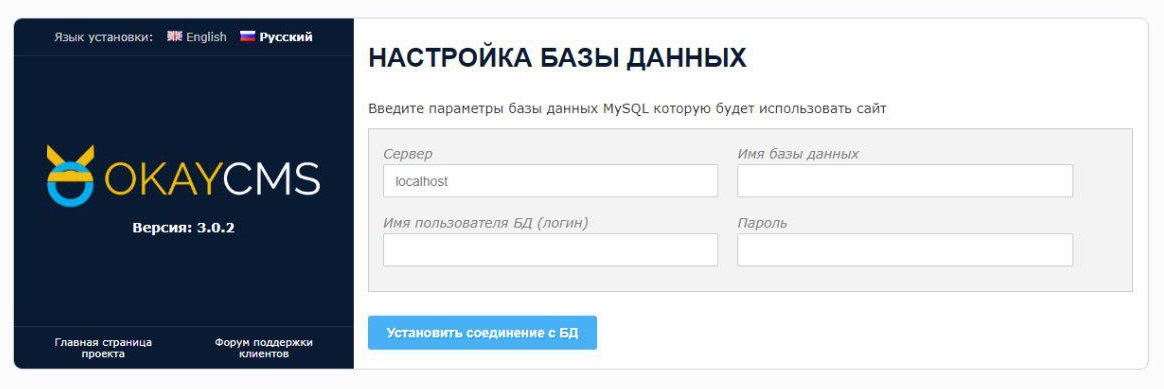
At the next stage, we configure the database. All the necessary data will be specified in the hosting panel.

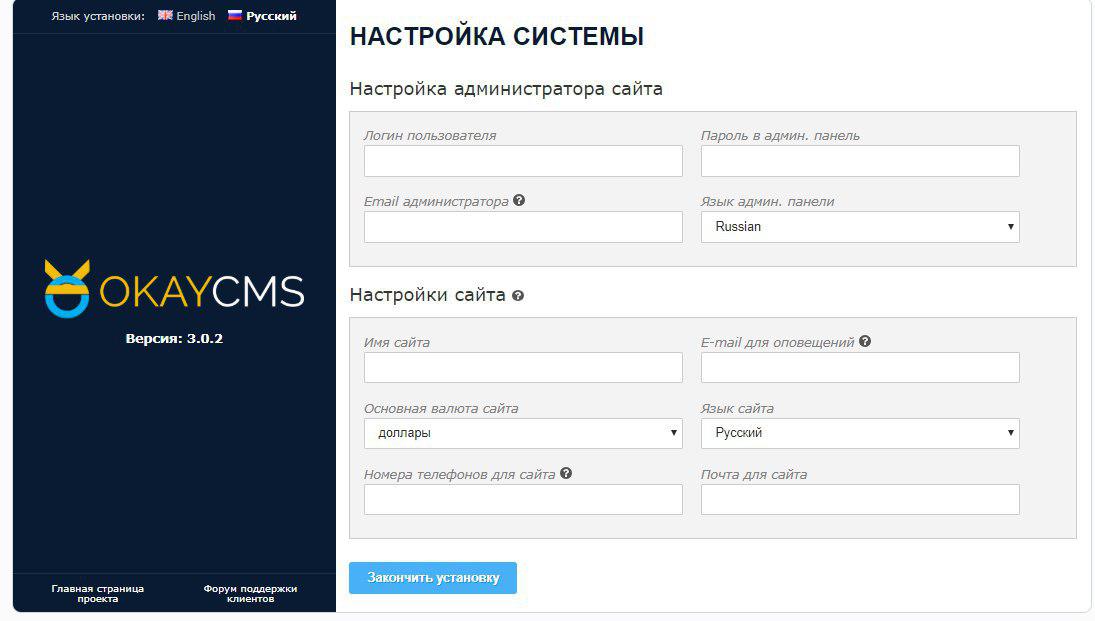
All that remains is to configure the system. Come up with a site name, user login, and password. Be sure to add "Email specified when purchasing add-ons" (without it, it won't proceed), that is, your own email.

At this stage, there was another unpleasant moment, namely the presence in the list of "Default region for phone number" — Russia. And here it is very important: on March 1, 2022, the project team published an official statement "OkayCMS Sanctions for Russians", in which founder Vitalii Vladov clearly condemned the aggression and stated that the company ceases any sales and support for users from the Russian Federation. There are no currencies of the aggressor country and add-ons for it. Thus, the presence of Russia in the installer dropdown list is not a sign of the developers' loyalty to the aggressor, but rather another confirmation of the code's neglect.
That's it, you have successfully installed the system. Now just go to the "Control Panel" where you can directly manage your online store on OkayCMS.
Pay attention to the red messages. If you are creating a site locally, then go to your folder and delete "install". If you are installing on hosting, then log into the "File Manager" in the Cityhost control panel, go to the root folder of your site, and delete "install" from it.
Also read: How to Create Your Own Business Website: Independently, Easily, and Relatively Cheap
Completing Training on Website Management

A significant advantage of OkayCMS is the help for beginners. The system is installed with test data, allowing you to analyze the work of each module, change the design, practice adding, editing, and deleting products, creating and publishing blog materials, and much more without fear of breaking anything.

Immediately after installation, you are redirected to the training page. Here you learn to add categories, brands, properties, products, and articles, manage orders, configure payment methods, and delivery options, etc.

You can click "Familiarize" in any module and proceed to training. But here, again, it is evident that there is a maximum negligent attitude towards the creation of the system: I chose the Ukrainian language, the module description was in Ukrainian, but the training was in Russian. And I do not know if there was such a mix of different languages before. However, if it was the case before 2021, then people paid $295 for such mistakes.

It turned out that you can change the language of the control panel in the user's personal settings. However, this raises the question: why then add a language switch? It seems to work, but it only changes the content display, while the system language of the administrator interface is rigidly tied to the "Manager" settings.

We used this function and set the English language. The control panel indeed became English, but the training remained in Russian.
Also read: Refusing the Russian Direction: How to Reorient Your Business to the West
Basic Settings of the Online Store

In the "Site Settings" section, you can change the name of the web resource, date format, email address. If you are conducting large technical work, the system allows you to disable the online store and display a corresponding message to users. You can also connect reCAPTCHA, choose its type, where to display it, and whether to collect and process data. There is no automatic application of changes, so always remember to click the "Apply" button.

An important section is "Catalog Settings", which allows you to change the number of products per page and in orders, configure price displays, and deferred loading of filters. In this section, you can instantly clear either the entire product catalog or individual categories, brands, products, properties, blog. That is, you can practice on test options now, and then clear all data from the site and upload the products you need.
Design Settings for the Online Store

After installing OkayCMS, you receive a nice free template that has all the necessary functionality for an online store. Later, you can delete all test data, configure modules, change colors, fonts, icons, etc., creating a stylish unique platform for selling products.

And we do not say "unique" for nothing. In the "Template Files" section, you can independently edit all possible files that directly affect the display and operation of the site.

In the "Design Settings" section, you can change everything that affects the appearance of the online store. This includes the primary and secondary colors of the web resource, social media buttons (they are already installed, so no third-party extensions are needed), contact form, information about payment and delivery methods directly in the product card. There is an option to quickly add a favicon for the site in various formats, including png, jpg, jpeg, svg, ico. You can even add unique logo versions for different language versions of the site.

If you do not like the standard free theme, you can purchase one of the premium ones directly from the official website. Before purchasing, you can test the template by clicking the "View Demo" button. There is a separate article with a video on self-installing templates on OkayCMS.
Managing Products in the Online Store

OkayCMS has a huge number of built-in tools for managing categories, brands, properties, and products. Let's start with the ability to import products. To do this, go to the corresponding subsection of the "Catalog" section, click "Select File" (in the screenshot, you can again see that even the names of all buttons have not been translated from Russian during the entire existence of the system) and click "Upload".

The developers even provide an example CSV file so that you can see how to format the document for seamless product import.

The system allows you to conveniently manage properties right "out of the box". You simply go to the corresponding subsection of the "Categories" section, where you can create new and edit existing properties (name, URL, display in filters, values).

And of course, the main section — "Products". You can immediately select several products and activate or deactivate them simultaneously, mark or unmark them as "Best Sellers", change the brand and category. There is nothing special about this compared to other e-commerce management systems, but everything is arranged as simply and understandably as possible, which is already an advantage of OkayCMS.

On the product page, you can specify the name, URL, add photos, variants of one product, for example, if it is available in different sizes or colors. There are full forms for creating a short and full product description.
The integration with ChatGPT allows you to instantly create title, description, and keywords. Just remember to go to the "Site Settings" section → ChatGPT and add the API key beforehand. There, you can also configure templates for product, category, and brand queries.
Also read: The Best AI Services for Content Creation: From Texts to Images
Setting Up Search Engine Optimization for the Online Store

OkayCMS provides the necessary tools for optimizing not only individual pages, categories, brands, and products but also for comprehensive SEO of the online store. In the "Indexing Settings" section, you can configure the canonical attribute and the robots meta tag.

A feature of OkayCMS is the ability to automate the promotion of thousands of pages. In the "SEO Filters" section, you can configure the creation of unique pages from product filtering results. That is, the user selects the category "Chairs" and the brand "Bag chair", and the system creates a separate page. Then it generates unique metadata to gather traffic for narrow queries like "buy a black leather office chair" without creating such pages manually.

The "SEO Products" section provides the same functionality, only for products, while the "Property Synonyms" section is more interesting. It allows making the text on generated pages "human-like", improving user experience and semantic search. For example, you can specify that "Screen", "Display", and "Monitor" are synonyms for one property. Then, if a buyer searches for "display", Google will be able to find your product even if the specifications say "screen".

I read reviews of OkayCMS on other sites that often mentioned the complexity of the system and the need to understand the code. And this is a false statement! Of course, if you understand the code, it will give you much greater opportunities for expanding functionality. But even without this, you can add your own code to the online store through the "Counters and Codes" section.
OkayCMS — A Technical Dead End in 2026
OkayCMS is a Ukrainian content management system for online stores that had the potential to become the best not only in Ukraine but also in the whole world. The developers could have added integration with other AI tools, international payment systems for selling products in other countries, and promoted the brand in the international market. Instead, they chose the concept of "a project on life support": the last release was recorded on December 19, 2024, the official website and social networks have not been updated for 15 months, and the main activity has moved to Telegram for selling modules and templates.
Although I initially had a negative attitude towards the system due to numerous errors in language versions, after familiarizing myself with the functionality, I was left with only positive impressions. I had never created online stores before, but here I instantly received a configured platform for selling products absolutely for free. Moreover, immediately after installation, the system provided full training, and at every step, it offered clear prompts. I am not even mentioning all the possibilities for adding and managing products, configuring design, search optimization, which you could see for yourself.
And you might ask: what's the problem, the system works? It really does, but the lack of updates can lead an online store on OkayCMS to the following problems:
- Conflict with hosting. The last version has not been fully tested on PHP 8.2+, which means that after the next software update on the server, your store may simply display a "500 Error" or start processing the cart incorrectly.
- Integration issues. The online store depends on APIs (Nova Poshta, Monobank, Google Merchant Center, etc.) that constantly update their protocols. Accordingly, you may encounter a situation where customers cannot select a branch when placing an order;
- Cumulative vulnerability. OkayCMS has not released security patches for the core since December 2024, making your store an easy target for automated scanners each year.
- Scaling ceiling. As the catalog grows and the number of simultaneous sessions increases, the load on the MySQL database grows exponentially due to unoptimized queries that have not been fixed for years. With a small catalog, there will be no problems, but stores with 10,000+ products will start to "lag", negatively affecting Core Web Vitals and positions in Google.
Considering the advantages and disadvantages, especially the aforementioned risks, the decision to create an online store on OkayCMS should be based on your own goals:
- If you need to quickly launch a site without investments (except for hosting and domain) and test a niche, then the system is perfect.
- If you are the owner of a medium or large business, it is better not to take risks due to the lack of security patches and the complexity of further scaling.
OkayCMS in 2026 is like a vintage car: it looks good, is very comfortable to drive, but its spare parts are no longer officially produced. And the system works well if you don't touch anything. But as soon as you want to add a new payment system, change the PHP version on the server, or simply update the list of Nova Poshta cities, you will find yourself in a technical dead end, the way out of which will cost more than using professional platforms.