

- What is «Powered by WordPress» in the footer
- How to remove the «Powered by WordPress» text: step-by-step instructions
- Why you cannot hide the Powered by WordPress text via CSS
- What to write instead of «Powered by WordPress»
You install a new theme, look at the future site, and notice in the footer «Proudly powered by WordPress» or «Built with [theme name]» with an external link. If earlier the process of removing or editing this text required programming skills, by 2026 for most templates everything can be resolved with two or three clicks in the settings. However, with some themes, the situation is more complicated. So I tested 6 different templates in TasteWP and the WPCode code insertion plugin, and I suggest looking at all modern methods: from one click to code editing — depending on your theme.

What is «Powered by WordPress» in the footer
«Powered by WordPress» («This site runs on WordPress») — is a technical signature on WordPress sites that appears after activating most templates. The CMS does not integrate this text by itself. It is inserted by the theme, so you will have to edit it through the PHP file footer.php, the Customizer settings, or the Site Editor.

Example of the text «This site runs on WordPress»
Most often, you can see such link options in the footer:
- «Proudly powered by WordPress» — typical for all default themes: Twenty Twenty-Three, Twenty Twenty-Four, Twenty Twenty-Five. In 2026, WordPress did not release a new default theme — Twenty Twenty-Five remains relevant, and Twenty Twenty-Seven is expected in 2027;
- «Built with [theme name]» — the author's or company's custom signature, for example, «Built with GeneratePress» or «WordPress Theme by CreativeThemes»;
- «Designed by Elegant Themes | Powered by WordPress» — the style of premium themes like Divi, where both the template and the CMS promote themselves together.
This text at first glance does not harm anyone, especially since the links lead to the official web resource of the CMS or the developer's site. However, a footer with foreign names and links looks incomplete. And the external link to a third-party resource takes away part of the link weight of the page and forces users to leave your internet project. Moreover, the open information about the content management system and the specific theme simplifies the hacking process for malicious actors.
Also read: How to protect your WordPress site and not become a victim of open code vulnerabilities
Previously, in addition to classic inscriptions, developers often added hidden links in the footer. Between 2014-2016, I had a small Ukrainian-language site about business ideas, from which I earned my first money on AdSense — a whole $0.21 for June 2016. I was using a free magazine theme that added the text «Built with [theme name]». Although I no longer remember the name of the template, I will always remember how I tried to find this line through footer.php or functions.php. And before selling the project, I found out that it had dozens of hidden external links.
At that time, I did not understand what it was and simply installed another theme so that the buyer would not have any questions. It turned out that this was base64 encoding — a way that some developers of free themes hid advertising code from the site owner’s eyes. Technically, it looked like a meaningless string of characters inside the PHP function eval() — no text and URL. If you knew what to look for — base64 can even be decoded online. But the problem was different: back then, most website owners, including myself, did not even suspect that there was anything in footer.php other than the usual text.
The scheme for theme authors was profitable: they placed links to paying clients in the footer — payday loans, casinos, «SEO services», cheap insurance. Your web resource spread this advertising without your knowledge. Some of these links were invisible to visitors but were perfectly readable by search bots — in fact, cloaking, which Google explicitly prohibits and punishes with lower rankings or penalties.
Some developers even added something resembling a legal warning above the encrypted code: «This file is protected by copyright law. To reverse engineer or decode this file is strictly prohibited». Meanwhile, the GPL license allowed modifying anything, so such a warning had no legal force.
Over time, the situation changed. WordPress.org tightened the requirements for themes in its official catalog: it banned encrypted code, mandatory external links, and hidden advertising content. Such themes disappeared from the official catalog. In 2026, the risks of hidden links remain only in templates downloaded from unofficial sites, so I advise you to remember the rule «download themes only from wordpress.org or from a verified developer».
How to remove the «Powered by WordPress» text: step-by-step instructions
Most modern themes, including Astra and Blocksy, allow you to instantly remove or edit the text «This site runs on WordPress» through appearance settings. Some themes, especially default ones like Twenty Twenty-Three and Twenty Twenty-Five, also allow you to do this quickly through the design settings in the Appearance → Editor menu. And some templates like GeneratePress hide the signature, requiring manual code changes or the use of plugins.

In the screenshot, you can see the settings I used to test all options on fresh sites in TasteWP.
Important! If changes do not appear after saving in any way — clear the WordPress cache (WP Rocket, LiteSpeed Cache, W3 Total Cache, etc.) and check the page in incognito mode.
Quick removal in block themes via Site Editor

A block theme (Full Site Editing, FSE) is built on HTML blocks. The entire site, including the footer, is edited in the Site Editor through Appearance → Editor. There is no footer.php in the traditional sense; there is usually a template file in the /parts/ folder. In such themes, there is an Editor item in the Appearance menu.

I tested this method on Twenty Twenty-Three. Immediately after installation, the footer displays «Proudly powered by WordPress», where the word WordPress is a link to wordpress.org.
To remove the text in Twenty Twenty-Three:

- Go to Appearance → Editor.

- In the left menu, select Patterns → Footer and click on the name of the pattern.

- Click on the text block with the text «Proudly powered by WordPress».

- Delete the block (Delete key) or replace the text with your own.
- Click Save.

The screenshot shows the result: after saving, the footer displays only the replaced text. Changes are saved in the database and will not disappear after updating the theme — this is a fundamental advantage of block themes compared to editing PHP files.

I also tried Twenty Twenty-Five. Here the steps are identical, but in the Patterns → Footer section, you will see not one but three patterns: Footer, Footer Newsletter, and Footer Columns. After editing each, check all pages of the site to ensure the absence of the text and external links.
Removal through settings in classic templates
A classic theme is built on PHP files. The footer and header are defined in footer.php and header.php. Design and settings can be managed through the admin panel. In the control panel of the web resource, in the Appearance section, there will be Customize, but there will be no Editor section.
One of the most popular WordPress themes for several years has been Astra. Bohdana Haivoronska, content marketer at Cityhost, noticed the Powered by WordPress text on her personal site using the Astra theme. And she shared a step-by-step guide to removing it:
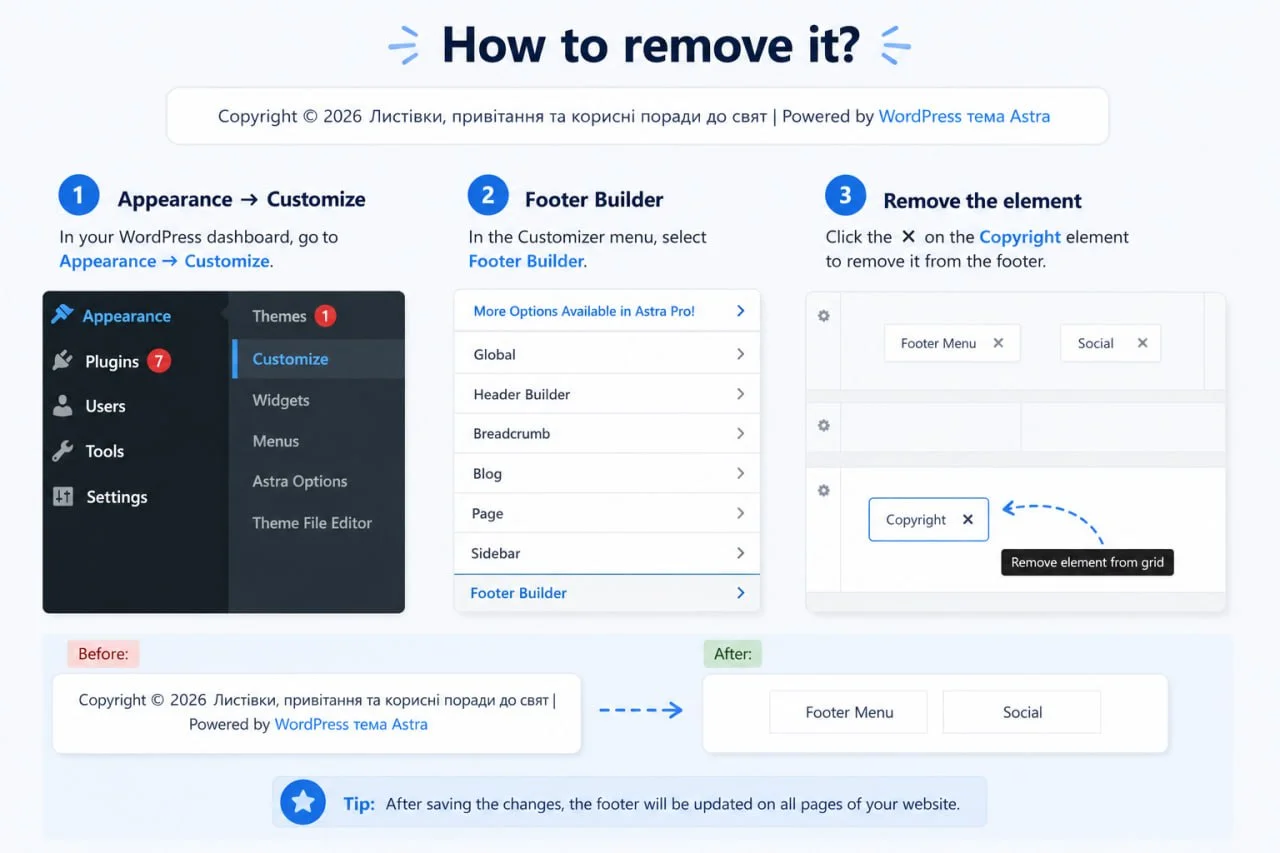
- Go to Appearance → Customize.
- In the theme settings menu, select Footer Builder.
- Find the Copyright element and click «×» next to it to remove it from the footer.
- Click «Save changes» — the footer will update across the entire site.
I use another popular WordPress theme — Blocksy on my English-language site. It also has a similar text: «Copyright © 2026 - WordPress Theme by CreativeThemes» with a link to the developer's site.

The approach to removing or editing the signature is similar, but the specific steps are a bit different:

- Go to Appearance → Customize and select Footer.

- Find the Copyright block — there will be a template Copyright © {current_year} - WordPress Theme by {theme_author}.

- Replace or remove part of the text.
- Click Publish.
The advantage of these themes is the instant display of changes. The new Copyright appears immediately in the preview window on the left — no need to manually refresh anything. And the changed text remains even after updating the template.
Editing the text in WordPress themes without a footer builder

GeneratePress — is a popular WordPress template that is perfect for both beginners and professionals who want to change the code directly from the site management panel. Here, the text «© 2026 Powered by • Built with GeneratePress» appears immediately in the footer with a link to the developer's web resource.

I tried to remove it in the same way as in Blocksy: Appearance → Customize → Layout → Footer. However, I only found appearance settings: height, padding, columns. No text field.

Then I went to the Theme File Editor, found Theme Footer (footer.php) — and saw PHP code with hooks: generate_footer, generate_construct_footer. I am not a website developer, so I had to search for information online. It turned out that the text «Powered by» is located in this part, but I was afraid to change anything. Moreover, there is no sense in editing the parent theme file directly, as all changes will be overwritten after the first update of GeneratePress.

However, during my search, I found a separate code that allows either to change or completely disable this text. And here the plugin that I already use on my site — WPCode helped me. It allows you to safely add PHP snippets without the risk of breaking the site, and you can instantly disable the code if something goes wrong. You can download and activate it directly from the official WordPress repository.
So I will tell you how to edit the Powered by WordPress text through WPCode:
- Install and activate the plugin.
- Go to Code Snippets → Add Snippet.
- Click Add Your Custom Code and select PHP Snippet.
- Insert the following code:
add_filter( 'generate_copyright', 'my_custom_copyright' );
function my_custom_copyright() { ?>
© <?php echo date('Y'); ?> Your site name
<?php }
In this code, date('Y') will always automatically insert the current year, so you do not have to change it manually every time.

All that remains is to switch Inactive to Active and click Save Snippet. As you can see, the text has changed to my own. The changes applied across the entire site, so every page will have the same signature.
If you want to completely remove the Powered by WordPress text with WPCode, then do the same steps, just use this code instead of the old one:
add_action( 'after_setup_theme', 'remove_generate_credits' );

function remove_generate_credits() {

  remove_action( 'generate_footer', 'generate_construct_footer' );

}

Important! This instruction is exclusively for the free version of GeneratePress. If you are using GeneratePress Premium, then go to Appearance → Customize → Layout → Footer → Footer Credit field and replace or remove the text there, without any code.
Why you cannot hide the Powered by WordPress text via CSS
If you have already studied other web resources, you probably encountered such a «simplest way»: writing in Additional CSS the line display:none or visibility:hidden for the element with the credit. It does seem simple, but in reality, this is the worst method possible.
The CSS method does not remove the text from the page, it merely hides it from the human eye. Google indexes the content of the page along with hidden elements, so the links and text remain visible to the search bot. And for Google, this looks like a hidden link — a separate category of violations in Google Spam Policies, for which a drop in rankings or a manual penalty is possible.
What to write instead of «Powered by WordPress»
Usually, people simply write the current year or period (from the creation date to the current year) and the name of the internet project — that’s what I did on my web resource. Some add links to legal pages or contacts. If this is your personal blog, then you can insert your name or your agency.
So here are a few ready-made templates for what to write instead of «Powered by WordPress»:
- © 2026 Site Name. All rights reserved. — minimalist standard
- © 2026 Company Name | Privacy Policy | Contacts — for GDPR-compliant sites
- Developed by [your name or studio] · © 2026 — if you want to indicate authorship
- © 2026 Author's Name — writing about [topic] — for personal blogs
2026 is just an example. You can use shortcodes {current_year} and [current_year] or the code © <?php echo date('Y'); ?> — depending on the theme.
The text «This site runs on WordPress» — is a question that in most templates is resolved instantly. If your theme does not provide a simple button in the Customizer — WPCode will solve this safely and quickly. The only thing you should not do is leave someone else's signature in the footer indefinitely: it takes up space that your brand could occupy itself.