

- What is outreach - in simple terms
- When outreach can be harmful
- How to make outreach safe and beneficial
As Google's rules are constantly changing, they often call into question old proven SEO methods. However, it takes time to assess how updates have affected the effectiveness of these methods. Guest posts and reciprocal links have always been an important part of promoting a website online and maintaining its positions. But is this still the case in 2026? Let's figure it out.
In short: a successful website should work like a small media outlet, not like a link farm. The more organically this is done, the more benefits it will bring. This fits organically into the modern trend of humanizing everything we do online - relevant texts instead of keyword-stuffed spam and personal experiences in articles instead of rewriting someone else's blog posts, etc. If the content appeals to readers, it is likely to please search engines as well. Now, let's move on to the details.

What is outreach - in simple terms
To promote a website, external links from other thematic resources are needed. They help search engines understand that the site can be trusted. One common way to obtain such links is by publishing guest materials on other platforms. They can vary in length, from a few lines to a full article. The type of material can also vary - completely promotional material, an interview with one of the employees, advice where you were asked for your opinion as an expert, or an honest review or guide where a link to your site may be appropriate.
Google takes into account the relevance of a site to user queries when ranking. It considers links as a signal of such relevance, so more links mean better positions. However, in practice, this relationship is much more complex.
Also read: How Google considers links from multilingual versions of a site: together or separately
When outreach can be harmful
- Systematic link exchange
- Commercial anchors
- Template exchange of guest articles
- Ring and triangular reciprocal links
- Low quality of texts and a focus on quantity
- Low quality of platforms where articles are placed
- What Google does if it detects these signs
- Google's position in rules and public statements
Anyone who has been involved in managing a website or its development and promotion for a long time probably remembers the huge link dump sites, attempts to place links in directories, any blogs that are even slightly related, Wikipedia (where such links were often removed, although there were successful cases) - in short, who knows where else. Sometimes entire sites were specifically designed to host ads, a lot of ads. And, of course, they were used. Many sites and blogs also actively exchanged links with each other, creating reciprocal links, and such barter remains widespread to this day.
However, we know that search engine algorithms are becoming increasingly complex and take into account more and more nuances. The SEO effect of such mass link exchanges and guest posts is declining.
Google wants to see that a site is useful and does not want to see spam. This is the main rule that also applies to outreach. Therefore, a campaign for placing guest posts can lower a site's positions if it shows signs of artificial link building.
So, what should be avoided so that Google does not perceive outreach as link manipulation?
Part of the answer to this question can be found in how Google generally views non-thematic and commercial content on authoritative sites - even when it is not directly about outreach.
For example, here's a quote from The Verge, a major publication about media and technology, from 2024: “An example of 'parasite SEO' content could be a news blog that publishes coupon codes for online shopping in a hidden part of its site, or an educational site that publishes affiliate marketing content unrelated to its theme. In March, Google announced that it would crack down harder on such 'site reputation abuse,' and it now clearly states that it does not matter whether the publisher created this content themselves or outsourced it - in any case, it is a violation of search policies.”
Here are the main signs of outreach from the perspective of search engines. In general, it is advisable to avoid systematic approaches.
Also read: What are nofollow and dofollow links, and why both types are needed for SEO promotion of a site
Systematic link exchange
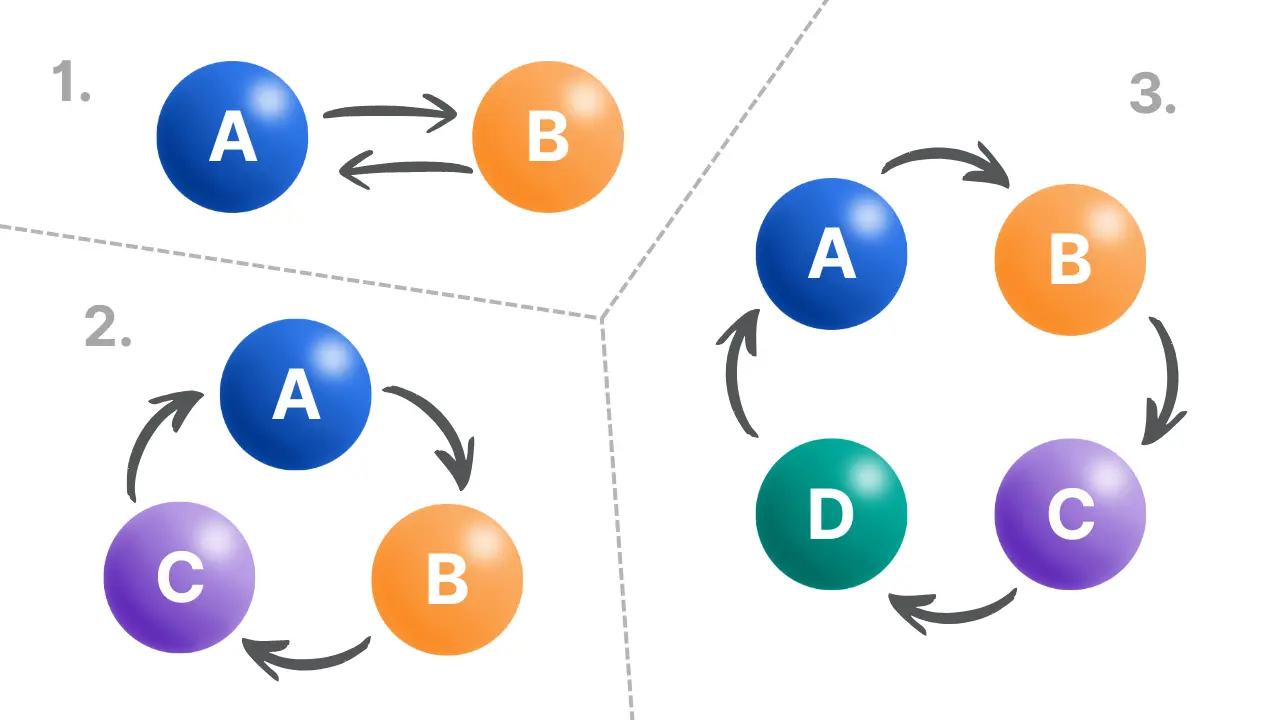
If there is a constant reciprocity in links, where one site constantly links to another, and that one reciprocates, it signals to search engines that something is wrong. Roughly speaking, if a site constantly receives links from the same resources it links to itself - this draws attention.
Commercial anchors
Of course, this is not about completely abandoning commercial anchors, but about situations where only they are systematically used in reciprocal links - this is dangerous. For example, “buy hosting,” “best VPS,” “cheap domain names,” etc.
Template exchange of guest articles
This can be particularly problematic if you have planned an exchange, created the same brief, and written several similar materials. Google pays attention to expressed reciprocity:
- exchange “article for article” within a short period;
- similar or even identical structure of materials;
- identical anchors;
- style (search engines catch style quite well because they constantly process large amounts of information).
If several of these signs coincide - it is very likely that there will be problems.
Ring and triangular reciprocal links
If at first we talked about simpler schemes like A-B, B-A, there are also more complex options, for example, A → B → C → A. This is definitely perceived as a scheme, even if all its participants swear that they are only connected by friendship.
Low quality of texts and a focus on quantity
The internet is filled with materials that copywriters have essentially rewritten from each other over many years. Errors and factual distortions travel from text to text, and usefulness declines. This is what Google is fighting against. If the author does not understand what they are writing about, or if you use unedited AI texts - this is bad for the site. It is equally bad if guest posts are created in this way. This, by the way, does not mean that using AI is not allowed. AI is a great tool that works for brainstorming, structuring text, and other tasks, but you cannot trust it completely and publish the first result of its work from an imprecise prompt without even proofreading it.
Also read: How to write prompts for AI correctly: learning to use artificial intelligence
Low quality of platforms where articles are placed
Link dump sites now do more harm than good for search positions. Automated campaigns also harm.
It can also damage a site's reputation if it is massively linked to by sites with weak positions in search results, low traffic, or those that are themselves under sanctions.
What Google does if it detects these signs
There won't be an immediate penalty. But Google reduces the weight of links so that even if there are many, they hardly affect the results.
Here’s what Google employees note about outreach in their guidelines for developers: “The following factors, if taken to extremes, may indicate that an article violates these guidelines:
- Articles rich in links to your site, with many keywords in the links;
- Publication of articles on many different sites; or, conversely, a large number of articles on a few large sites;
- Involvement of authors in creating articles who are not knowledgeable about the topics they write about;
- Use of identical or similar content in these articles; or, conversely, duplication of the full content of articles found on your own site (in this case, in addition to rel="nofollow," it is also recommended to use rel="canonical").
Google's position in rules and public statements
Manual sanctions for violators are usually rare, but here is a piece in Search Engine Land discussing manual penalties for sites and quite serious sanctions in the spring of 2024 when policies were updated.
And here is a piece in Reuters discussing how companies began to complain (and literally file complaints with regulators) about their rankings sharply declining. This happened after Google implemented a stricter crackdown on mass placement of spammy guest posts.
Google considers excessive and spammy guest posts as link spam and will penalize for it.
Therefore, outreach should be approached cautiously and without attempts at manipulation.
How to make outreach safe and beneficial
- Avoiding direct reciprocity
- Time gap between publications
- Diversity of formats and mentions
- Transparent marking of partnerships
- Quality materials
- Quality of platforms
The task is to work as if you are running a blog or industry media without any promotional intentions. Everything should look natural: you want to provide value to readers and write interesting materials for them. Occasionally, you are asked for your opinion or you write author columns in media on the same topic. Similarly, you can invite guest experts to your platform.
Here we can offer some advice based on our own experience: Cityhost has quite strict rules for placing guest posts, and they work. To summarize our practices, we can say: we do not have many partners, but these partners are very valuable to us.
Here are some rules.
Avoiding direct reciprocity
Link placements should not look like a classic “you scratch my back, I’ll scratch yours.” It is worth placing links to other sites just like that, without obligatory reciprocity. And if links in response are made to you, do not repeat this immediately and in a typical, similar article. Moreover, in a guest post, one branded link (to the homepage or a useful guide) looks more natural than “5 SEO anchors under keys.”
Bohdana Haivoronska, a content marketer and editor of the company’s site, shares her experience with outreach: “One service contacted me several times. Moreover, different managers constantly wrote - either they have so many, or they were changing... And each offered outreach, not knowing that we had already collaborated. So we exchanged links three times, trying to give links to different pages from our side. After that, we no longer continued outreach because we decided that three articles with links from each side were quite enough.”
Time gap between publications
If an external site places a link in exchange for a link, there should be a time gap between actions. For example, you place a link to a certain blog, and a month later they place a link to you.
It is best if there is a real reason for placing the article - a thematic interview, a joint promotion, a challenge, an important industry news, etc. The worst case is if it is an article whose topic was developed solely for anchors, and it appeared immediately after a similar article from a partner.
Diversity of formats and mentions
It is worth placing links to different types of pages. For example, if you publish an article, then for you, in a month or a few weeks, there may appear a case or review, some other material mentioning the brand, such as an author column, guide, advice.
Google classifies “widely distributed links in the footers or templates” as link spam and guest/PR materials with optimized anchors (here we have to refer again to Google’s own guidelines). Therefore, modern outreach should be very restrained and not chase the coverage of hundreds of platforms.
Also, do not limit yourself to identical anchors. For example, a uniform anchor in an article about you and about your partner is a bad idea. Let one of the participants in the exchange place a direct URL, the other simply mention the brand, the third write neutral text and link. This will allow you to look good to the search engine.
Transparent marking of partnerships
In fact, Google does not prohibit outreach completely; Google allows it if sponsorship is openly marked (both as a label that this is a partnership/sponsored article and, for example, rel="nofollow" or rel="sponsored").
Quality materials
In the practice of marketers, content writers, or SEO specialists, there have often been situations where guest posts were handed over for work on a residual basis - outsourced or done independently, but with the last strength and without particular attention to quality. After all, the main goal was to place as many anchors and links as possible. Now there may be a temptation to do the same.
But we remember the main thing: you act as if you have an industry media, and your partners act the same way - that is, everyone publishes interesting and well-thought-out articles. This is not so difficult if you think about it: you are truly experts in what you do, and you surely have something to say about it. Besides Google, live readers who come to your posts from the search engine will appreciate this.
Google considers that an acceptable goal of placing guest posts is: “To inform readers of another site and increase brand awareness.”
Google directly states that it does not discourage contributor/guest/partner/syndicated posts when they “inform users, educate the audience of another site, or raise awareness of your company/cause.”
In this case, it is quite acceptable to give a link to the source (that is, to your site, so users can check for themselves).
In this case, links are perceived as a signal of relevance, usefulness of the site (it is desirable to have a meaningful anchor for them).
Good posts are those that provide knowledge or emotion and carry real value for the reader. Therefore, before publishing material, you can ask yourself a few important questions:
- Is this topic interesting to the readers of the site?
- Is the author of the article knowledgeable about what they are writing about?
- Is there something unique here? Is this not part of a mass campaign to create duplicate content?
- What do we give to the reader?
- If this is a sponsored column, is it marked accordingly?
A honest answer to these questions is one of the best ways to avoid problems and make outreach a method of promoting the site, not a source of complications.
Cityhost relies on these rules as the foundation of our work. We do not seek ways to circumvent them; we are inspired by them because they are the guarantee that the site will have quality content. Ultimately, everything is done to ensure that readers return to us and specifically to our blog again and again.
Bohdana Haivoronska: “We write the best articles for our partners, just like for ourselves. We expect that people will read them, not just search bots. Quality interesting material is a plus to our reputation.
We also demand quality texts from partners.
There have been times when we asked partners to rewrite everything from scratch. There have been times when we were asked to rewrite as well. Because mostly our partners are as demanding as we are.
Once we received a blank and “watered-down” AI-generated material, which I did not accept. The partner rewrote everything from scratch considering the wishes, and now it’s a highly rated article that other companies are asking to link to - they want to get a link from it. But we do not take them - that’s our principle, not to add other external links to a partner article. And besides, we are not a “link dump,” as mentioned above, so we refuse outreach more often than we agree to.
I think outreach is not only a way to get links and brand mentions but also a source of interesting professional materials for the blog. Therefore, we always ask to provide industry materials - for example, this way we received rare professional articles about why there are no calls from the site, from Ringostat, about IVR systems from VoIPTime, and business accounting in the cloud from Ukrainian Intelligent Technology».
Quality of platforms
It is always better to choose a platform carefully and thoroughly. In our practice, there have been situations where the administration of a certain site approached us with a proposal for cooperation several times, even offering a cross-link in the footer of the site. But the more mentions of you on one site, the weaker its overall metrics, especially when it comes to cross-links - the more this can play against you rather than for you. Especially at the beginning of work, it may seem that losing potential cooperation is regrettable. But in outreach, it is important to weigh the “pros” and “cons” very carefully - and to refuse the excess.
Links placed on sites with a strong reputation, stable traffic metrics, and search positions work effectively. It is important that the site does not look spammy, does not place materials in the gray zone (piracy, gambling, etc.), and does not publish guest posts too often. A quality thematic magazine or a site of a popular company is good; a site-platform for sponsored posts with dubious things is not.
At Cityhost, we take this very seriously. We often receive proposals to place guest posts, and sometimes we also look for platforms ourselves. But before agreeing to cooperate, we carefully check each platform.
Here are our main criteria:
- Trustworthiness of the site: there should be a score of at least 30 DR on Ahrefs without manipulation. We determine manipulations very simply - on the growth graph of domains, a vertical jump is visible. In this case, the number of referring domains can increase by several thousand in a week. We avoid such donors.
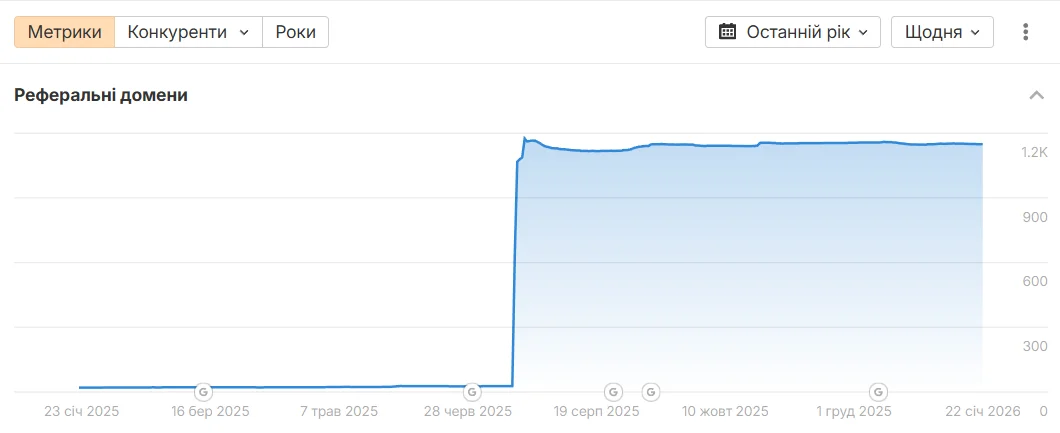
A sharp jump in the number of referring domains in just a few days - from 25 to over 1000. This is a sign of manipulation that Google also sees. Ahrefs statistics.
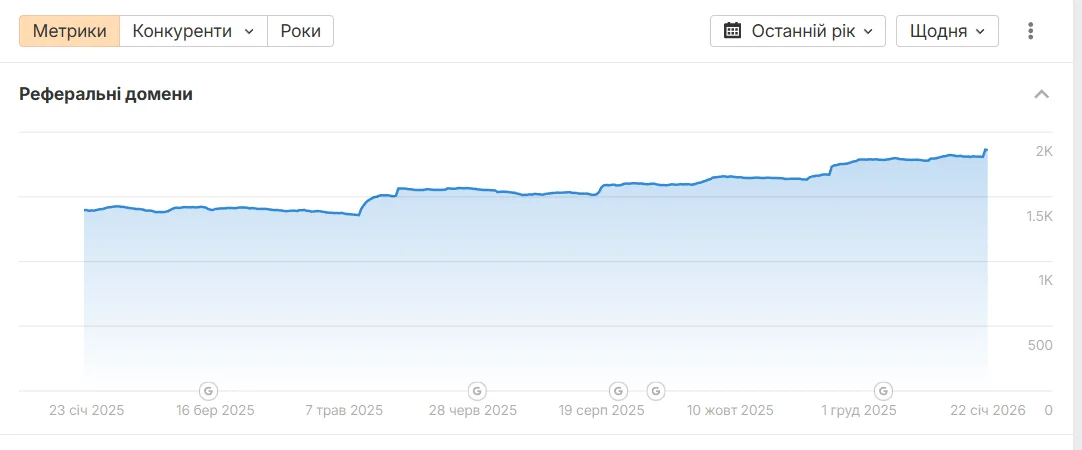
Example of organic and gradual link weight building - a sign of a donor with whom you can cooperate. Ahrefs statistics.
- Stable organic traffic. Due to AI-generated responses in Google, traffic has fallen on all informational sites and blogs, but we take this into account.
- Age of the site from 12 months. Newly created platforms can go different ways over time: either develop and become trustworthy or turn into spam resources and fall under sanctions. Until we know their prospects, we postpone cooperation.
- Thematic relevance to ours. Cityhost partners with other digital companies: website development and marketing agencies, SEO services, media dedicated to IT, etc. There are topics we avoid in outreach and in our blog in general - casinos, betting, cryptocurrencies. Besides being quite controversial topics, supporting and partnering with such services contradict our human principles - and they are shared within the team.
- Competent content and a well-developed site. We do not cooperate with low-quality web resources that are hastily made, where there are many errors in the materials.
- The site is not specifically designed for selling links and outreach. If during verification a colossal number of outgoing links is visible, and the content of the site shows that it does not aim to provide value to readers, we also avoid cooperation.
- The site or blog must be really cool, high-quality, with unique materials and made with the desire to share interesting content with people.
As you can see, with such principles, we do not have many outreach partners, but these are truly quality links.
After these tips, it may seem that outreach is too dangerous to engage in. However, it is a powerful tool for improving your site's metrics, bringing new audiences to it, and simply making your site even more interesting and useful for readers. The key here is restraint, thoughtfulness, and interest in partners - not as a number in a link table, but as colleagues, people, and experts in their field.