

- The British regulator has created an important precedent
- Reasons for CMA intervention in the work of AI Overview
- Why the success of AI search could become a problem for Google itself
- Is it enough just to add a link
- The next step — licensing content?
When Google launched AI Overview, many saw it as a new stage in the evolution of search. The user asks a question, and instead of a list of links, they receive a ready-made answer generated by artificial intelligence.
Undoubtedly, this is convenient for users, but for informational websites, news resources, and media, it has become a serious problem. After all, now the reader receives most answers directly in the search, without going to the site or browsing its pages. Because of this, the resource loses not only traffic but also the opportunity to make its domain name recognizable to readers.
We have detailed the traffic loss associated with the emergence of AI answers in search in this article: How to pull a site out of the traffic pit after Spam Update and AI Overviews.
But it seems that the first answer has been found in the UK.
The British regulator has created an important precedent
The Competition and Markets Authority of the United Kingdom (CMA) announced new requirements for Google regarding AI Overview and other AI functions in search.
The regulator believes that content owners should have more control over how their materials are used in generative search.

Sarah Cardell, CEO of CMA, notes:
«Given that features such as AI Overviews are rapidly changing online search, it is crucial that content publishers, including news organizations, have appropriate bargaining power over how their content is used. At the same time, these measures will help tens of millions of search users in the UK better understand and trust the information provided to them».
Google has already agreed to test new mechanisms for UK sites.
In short, informational resources will have the opportunity to:
- control the use of their content in AI Overview and AI Mode;
- remain in the regular search results even after opting out of participation in AI functions;
- receive more prominent links to their materials in answers generated by artificial intelligence;
- restrict the use of content for retraining models.
At first glance, this seems like a technical change. In reality, it is about a new principle of interaction between search engines and websites.
Reasons for CMA intervention in the work of AI Overview
After the launch of AI Overview, many media and news organizations began to report a decrease in search traffic. At the same time, website owners were effectively unable to prohibit the use of their content in generated answers and other AI functions of Google without risking losing visibility in search.
According to the CMA, this created an uneven playing field for content owners. Google controls over 90% of the search market in the UK, so for most informational resources, opting out of search traffic was an unrealistic option.
This imbalance between the platform and content owners is what the British regulator is trying to address with new requirements.

Why the success of AI search could become a problem for Google itself
AI Overview uses not only news but also data from blogs, reference resources, technical instructions, educational projects, and business sites. Because of this, the impact of AI answers goes far beyond the media market.
Content resource owners have already lost a significant portion of traffic after the emergence of generative answers in search. At the same time, Google needs quality content to operate AI Overview and other AI functions.
As a result, a vicious circle arises: AI uses materials from websites to create answers but deprives them of the incentive to produce quality content.
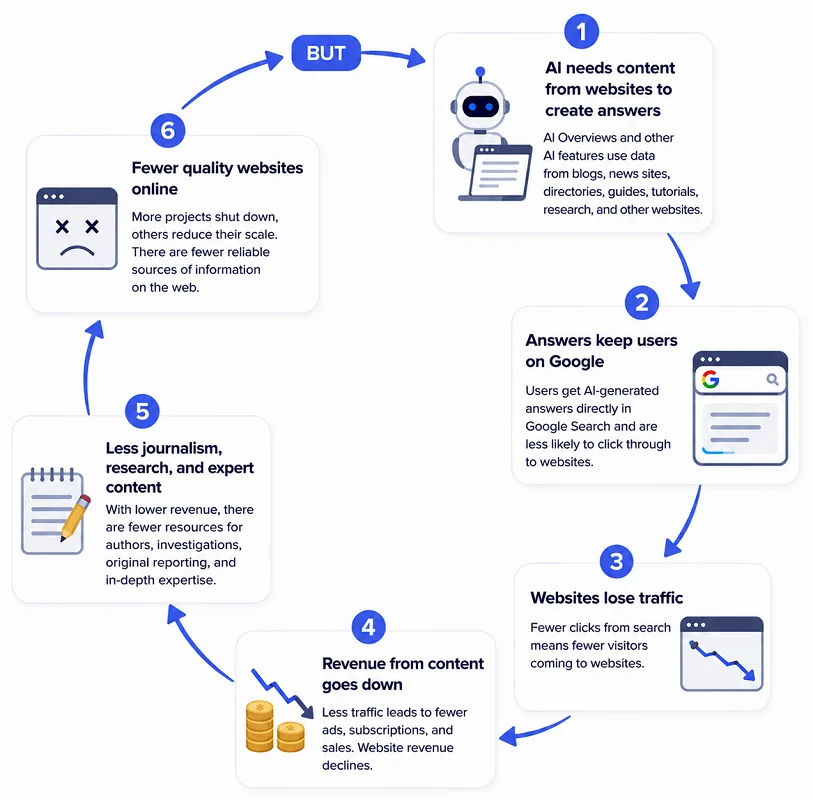
If traffic and profits of sites continue to decline, some projects may simply cease to operate. Then the AI search ecosystem itself will suffer, as AI requires constant access to current, quality, and independent sources of information.
Looking at this whole story, it's hard not to imagine a new creature of the digital age — Googloboros.
Like Ouroboros, the serpent that devours its own tail, it slowly consumes the sources of content that power its own AI search. The irony is that websites are not competitors of Google or AI search. They are its donors.
If those donors continue to lose traffic, revenue, and incentives to create quality content, the question will eventually arise: who will produce the information that future generations of AI depend on?
In fact, this is a question of the long-term viability of the entire AI search model. That is why regulators are increasingly talking not only about competition between search engines but also about the need to preserve an economic model in which the creation of quality content remains profitable for those who write articles and news.
Is it enough just to add a link
In recent months, Google has been actively increasing the number of links in AI answers. Sources have become more visible, and the answers themselves are more frequently accompanied by site cards.
This is a good step towards content creators, but it does not solve the problem.
If a person searched for a complex topic, they may click through to learn more. However, if the query is simple, the answer in search often fully satisfies the need.
For example:
- what is AI Overview;
- where to buy reliable hosting;
- how robots.txt works;
- what is a VPS server.
In such cases, the user often receives all the necessary information directly in search.
That is why the CMA's solution does not limit itself to the requirement to add links. The regulator speaks about the right of website owners to decide for themselves whether they want to participate in AI results.
Also read: What to do with FAQ after the cancellation of Google FAQ Rich Results
The next step — licensing content?
The CMA's decision does not require paying compensation to website owners for the use of their materials, but the very fact of the emergence of the right to opt-out may change the balance of power.
If large media or popular informational resources gain the ability to restrict the use of their content, Google will have to negotiate more actively with owners of quality sources.
That is why many experts call the current decision the first step towards future licensing models.
A similar scenario has already been experienced by music services, streaming platforms, and social networks. Initially, disputes arose over the use of content, and then new rules of cooperation were formed.
Of course, the UK is far from Ukraine, but for the whole world, the very fact that the regulator has directly intervened in the relationship between generative search and content owners is significant.
If the new mechanism proves effective, similar requirements may emerge in the European Union and other countries.
In this case, website owners will gain a new tool for controlling their materials. Much like how robots.txt once allowed deciding what could be indexed and what could not.
And it is quite possible that in a few years, allowing the use of content for AI will become as common a site setting as classic SEO methods are today.