

- When a hashtag works and when it does not
- How to use hashtags effectively: practical recommendations for different social platforms
- Rules for using hashtags in 2026
- When hashtags definitely won't work
A hashtag is a label after the # symbol that helps in searching for posts on social media. When you click on a hashtag, you land on a results page that contains all posts tagged with that hashtag. This way, the post is seen not only by those who follow you but also by random people. Importantly, these readers are potentially interested in the topic if they searched by the hashtag. Such an audience may be more receptive to your posts than completely random users.
Additionally, challenge and campaign hashtags help unite different content within one theme and maintain audience interest.
Many people use a simple approach: to add as many somewhat relevant hashtags as possible after a post in the hope that one will work. New trends are against this solution.
Recently, Instagram limited the number of hashtags per post to five. Check your account right now—you'll see for yourself. TikTok has also introduced a limit. Social network X has kept hashtags for regular posts but banned them for promoted ones. Personally, the author used to rely on hashtags to easily search among content in a closed Facebook group—they no longer work as they used to, only as a cross-search across the entire social network.
YouTube officially states: if there are more than 60 hashtags in a video, all of them will be ignored in the platform's search results. YouTube also generally considers hashtag abuse as spam.
It seems that the times when there could be more hashtags than text in a post on Instagram are over once and for all. Should we abandon them? In fact, when I peeked into the same Instagram, it turned out that many people are doing just that. Kristina Soloviy, the band "Tartak," the Instagram account of the "Charter" team—all these accounts simply live without hashtags. And Ryanair, which periodically delights with funny reels—too. The marketing agency Promodo also does not use any hashtags on Instagram.
Everything still depends on choice. Just working with hashtags is becoming more cautious. This fits perfectly into the overall trend of the Internet—to provide more value, less advertising, to talk more about clients than about oneself, to give users information they are genuinely looking for, rather than burdening them with your brand.
Hashtags can help people find you within the platform. But if you are building a long-term brand presence, it's worth working not only with social media algorithms but also with your own infrastructure. Users are increasingly moving from social networks directly to the website—for details, portfolios, or orders. In this case, it is important for the brand to have its own domain name that is easy to remember, and a stable reliable hosting that can withstand the load during advertising campaigns or viral mentions.
Read also: How to promote a website using social media
When a hashtag works and when it does not
First, let's figure out what to consider as the "work" of a hashtag. So:
- Is it indexed on the hashtag page? This page can be opened by clicking or tapping on the hashtag. In Instagram, there can be several such hashtags, in Threads—one per post, the same goes for hashtags in TikTok (now also limited to 5). Clicking on a hashtag leads to a search page for that keyword. In this sense, everything still works.
- Does the hashtag work for your specific reach? Here you need to look at the metrics to understand whether anyone is actually searching through these hashtags for something interesting or seeing your posts. A hashtag may be unpopular, and posts may only partially correspond to the hashtag. This affects views. Moreover, the order of posts in discovery by hashtag may depend not only on freshness but also on other factors, such as the overall popularity of the account, its activity, etc. For example, Instagram says about this. Therefore, to check how well your hashtag works for you, it is worth additionally verifying with the metrics. Usually, this is the traffic source tab—hashtags. In TikTok, it's trending hashtags. Look primarily in native analytics.
There are also reasons why hashtags definitely won't work: the account is private, and the post is closed from public view; the publication does not comply with community guidelines; the hashtag is deemed misleading or inappropriate (for example, as in YouTube).
Super popular hashtags that everyone uses, such as #viral, #FYP, etc., may not bring any benefit simply because a lot of content lands on the hashtag page every day.
If earlier we could just add a large number of hashtags to a post in the hope that one would work, now we need to weigh the benefits and harms.
Instead, a more niche hashtag will work better, but not completely unknown. This balance between trends and self-expression is what should be built.

Read also: The best AI services for managing social media
How to use hashtags effectively: practical recommendations for different social platforms
- Instagram: the new logic of hashtags—less but more precise
- YouTube: hashtags as a navigation tool and source of traffic
- Threads: one tag—one topic
- X (formerly Twitter): organic content instead of hashtag spam
- TikTok: search through tags, recommendations through viewer behavior
- Telegram: hashtags as navigation, not as a reach tool
A limited number—maximum benefit. The ideal balance comes from numerous experiments. Here’s what to keep in mind.
Instagram: the new logic of hashtags—less but more precise
Here’s one of the posts from the director of CreativeSmm, Marta Pasternak. Five hashtags. The idea is that you can choose fewer, but the settings won’t allow more.

This means in our case that she is not actually limiting herself: five is the maximum number. You can take three. The regulation of the number applies to both posts and reels.
I would like to show you how influencers use this. Look at how the number of tags under the posts of the series "Bridgertons" in Instagram has decreased.

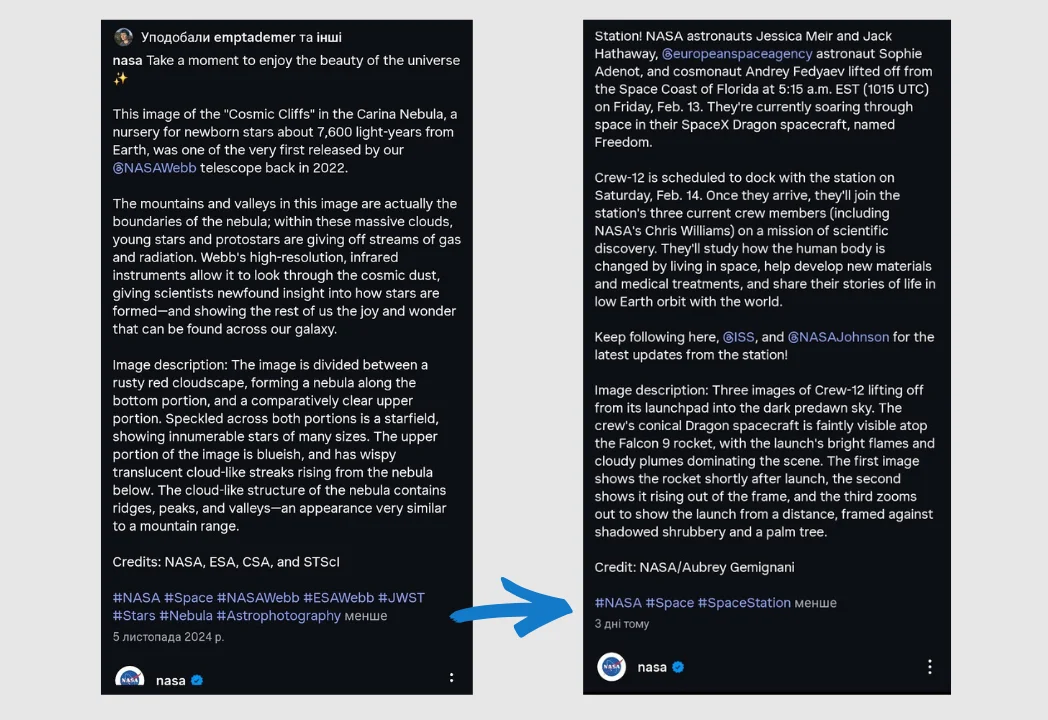
And here’s the NASA account (I highly recommend it for improving your mood. Just admire). The number of hashtags was not at the maximum possible, but it was still trimmed.
The Verge reporter quotes Instagram head Adam Mosseri, saying that hashtags should not be viewed as a tool for increasing reach, but as something that helps with content discovery. The key, he says, is for the audience to find the content that resonates with them the most. Mosseri asks not to use tags that are applied mechanically.
YouTube: hashtags as a navigation tool and source of traffic
YouTube allows the use of hashtags as a means of navigation, meaning that by clicking on a hashtag, you can reach a results page with that hashtag. As mentioned above, the social network prohibits more than 60 hashtags. If hashtags appear to be misleading, i.e., do not correspond to the video topic, you may receive sanctions.
However, YouTube not only has hashtag pages, but it also counts them as a source of traffic. They are needed.
Here’s a good video explaining how to better place hashtags now:
- In long videos—at the end of the description, in shorts—at the end of the title.
- Limit to three hashtags if the video is long. In a short, you can afford more.
- When typing a hashtag, look at how it corresponds to your topic and how people interact with it (this number usually appears in the list of hashtags that drops down when you start typing after the # sign).
- Avoid repeating the same hashtags.
Read also: Step-by-step guide to creating a YouTube channel with preparation for promotion
Threads: one tag—one topic
Here it’s simple—one tag-topic. There is an official guide that advises using it cautiously, so that your post is found by people interested in the topic, not just seen by everyone. Statistics in this social network are not as transparent as in Instagram, so it’s hard to understand how the topic works. However, you can make several posts with one defined topic and a few related ones, but without a topic, compare the reactions to them, and then draw conclusions.
Threads is a younger network than the rest, so there will be even more changes: communication rules still need to stabilize.
X (formerly Twitter): organic content instead of hashtag spam
Hashtags and keywords generally help a post appear in searches for that keyword. However, changes have also occurred there. The official position of the network is that X promotes a move towards greater organic content, against hashtag abuse.
Therefore, they ask not to abuse hashtags in any posts, not to use tags that do not correspond to the topic of the post, not to publish similar messages immediately from many accounts, and not to duplicate content. Anything that violates the rules may not appear in search results for the tag.
For organic reach, in addition to the fact that hashtags are completely banned for paid posts, they ask to generally refrain from them and pay attention to ensuring that the post contains keywords that look organic, that the text is not too long, and does not appear to be hastily written. Then, even if there are no hashtags, the post will perform better in search.
Stephen King manages without hashtags—and we can manage too.

Let’s look at Max Kidruk's account on X: there are either no hashtags or 1-2 per post.

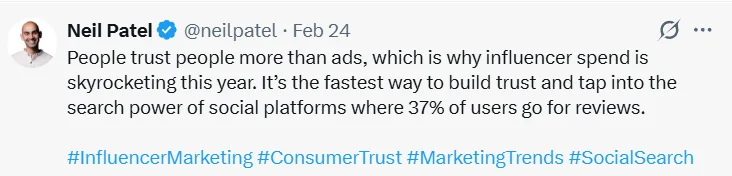
However, marketer and popular SEO blog author Neil Patel does not shy away from hashtags at all—he has 3-4 on most posts, and they are quite general.
TikTok: search through tags, recommendations through viewer behavior
Officially, in the social network, hashtags are called only one of the factors by which posts appear in search results and recommendations. There are countless additional factors—language and geographical location of the user, their previous interactions with content, audio tracks, likes.
Overall, it turns out that a hashtag helps with search, but likes and recommendations weigh more.
To select a few hashtags that will actually work, you can peek into TikTok Creative Center—Trend Discovery—Hashtags and see what’s popular. Selecting hashtags in TikTok should not take too much time. It’s much more important to create a video that holds attention: user interaction, watch time, likes, etc., determine how well the video will land in recommendations.
Nevertheless, hashtags help with navigation. Thematic hashtags in limited quantities are used, for example, by the Spotify account on TikTok.
Telegram: hashtags as navigation, not as a reach tool
In Telegram, hashtags work differently than in classic social networks. There is no algorithmic recommendation feed that promotes posts by tags. The platform does not "boost" posts through popular hashtags as it happens in Instagram or TikTok.
Clicking on a hashtag initiates a search. Initially, Telegram shows results within the specific channel or chat where this tag was used. The user can switch to global search, but in practice, most people use internal navigation.
Thus, in Telegram, a hashtag is primarily a way to structure content.
It works well:
- for large channels with hundreds of posts, where it’s important to quickly find materials on a specific topic;
- for regular sections;
- for thematic collections that come out periodically.
For example, if a channel publishes materials about SEO, hosting, or domains, it makes sense to use one stable tag for each direction. This allows new subscribers to quickly browse the archive on the topic.
At the same time, hashtags have little impact on attracting new audiences. Reach in Telegram is formed through subscriptions, post forwarding, mentions in other channels, and reader activity. The tag itself will not bring new people to the channel.
Therefore, the strategy for Telegram in 2026 is simple: 1-2 systematic hashtags for structuring, without excessive use. Here, the logic of the archive and ease of navigation is more important than trying to "catch" global traffic.
Rules for using hashtags in 2026
- Less is better, and it’s important to choose hashtags as closely related to the topic as possible.
- The hashtag must correspond very well to the topic of the post or video.
- Very general hashtags that were previously used "just in case" are becoming useless: they carry no weight, provide no benefit, but take up space in that same valuable list of 5-7.
- It’s worth using 1-2 niche hashtags or trending ones, only if that trend really pertains to you. If the business is local—appropriate local or language hashtags can be used to segment the audience. In X, you can refrain from tags altogether.
- Experiment, do not repeat the same set of hashtags every time. Something new may suddenly "take off" better;
- Search for hashtags in new directions—problems, emotions, impressions.
It’s also worth mentioning: by what hashtags we ourselves search for content. This will give at least a rough idea of what will work for promoting the account and what are just signs that we wasted time compiling.
When hashtags definitely won't work
Hashtags are absolutely useless if posts are private or restricted to a certain audience. Then posts will only be seen by those you would have shown them to anyway.
Furthermore, if you abuse hashtags or place them where the platform explicitly asks you not to do so—they will not increase reach.
Too general hashtags that everyone uses, and those that no one searches for, are also ineffective, especially overly niche ones. You need to monitor the metrics to see if anyone is coming through the hashtag, and remove from your lists those that do not provide reach.
If you track statistics, change hashtags, experiment—new readers will definitely find you. Just don’t consider the tag itself a magic pill that will help you go viral.



.webp)